
Customer conversations have transformed more dramatically in the last five years than in the previous two decades, and messaging channels sit at the center of that disruption.
Today, 97.3% of connected adults use at least one social media or messaging platform every month. (Source: Data Reportal) These users don’t just scroll passively; they expect real-time replies, in-conversation guidance, and the ability to complete actions without leaving the apps they already open dozens of times a day.
That expectation reshapes how businesses must operate. The global chatbot market is valued at $10.42 billion in 2026 and is projected to reach $60.21 billion by 2034 at a CAGR of 24.51% (Source: Fortune Business Insights, 2026). Simultaneously, conversational AI is on track to save businesses $80 billion in global contact center costs in 2026 alone (Source: Digital Applied). Chatbots on channels like WhatsApp and RCS have moved well past “nice-to-have” automation; they now function as a core business communication layer, the place where discovery, support, transactions, and engagement converge in a single thread.
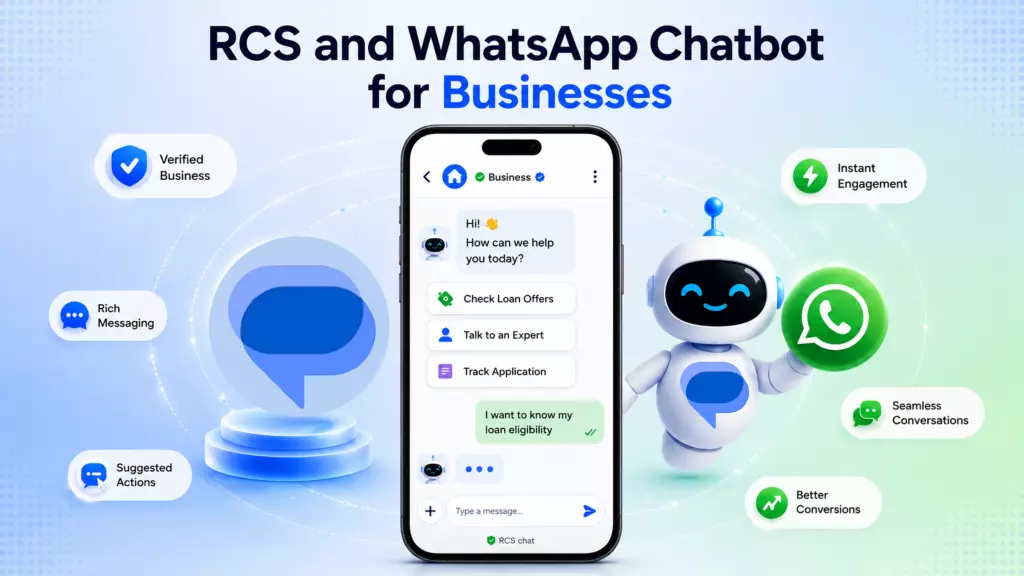
Among all messaging channels, WhatsApp and RCS stand apart because they combine scale with interactivity. WhatsApp commands unmatched global adoption and user trust. RCS delivers app-like rich experiences natively through the device’s built-in messaging client. Together, they form the strongest foundation available for conversational automation at scale. But before exploring how WhatsApp and RCS enable these experiences, it is important to understand the technology powering them: chatbots.
What Exactly Is a Chatbot?
A chatbot is an automated conversational agent that interacts with customers through text or voice. While the technology varies, the goal remains the same: helping users complete tasks, find information, or take action without requiring human intervention. Businesses report strong returns from chatbot investments, with studies suggesting significant gains in efficiency, scalability, and customer service outcomes. (Source: Ringly.io)
Every chatbot interaction follows a recognizable architecture, regardless of the channel:
- Trigger: A conversation begins when a user sends a message, free-form text, a voice input, or a tap on a menu option or quick-reply button. Specific keywords can also initiate predefined flows.
- Intent processing: The chatbot uses Natural Language Processing (NLP) to parse the message, correcting spelling, identifying grammar, recognizing intent, and extracting entities like product names, dates, or locations.
- Response generation: The bot maps the identified intent to a response, retrieved from a pre-programmed library or generated dynamically, and delivers it with follow-up prompts to advance the conversation.
Rule-Based AI Chatbots vs. Intent-Based AI Chatbots
- Rule-Based Chatbot: Operates on a fixed decision tree, predefined “if this, then that” logic. It only responds to specific keywords, button taps, or menu selections. It cannot interpret free-form language or deviate from its script.
A Real-world example for this category of AI chatbot can be considered as a business using ManyChat to automate WhatsApp order confirmations. A customer taps “Track My Order,” the bot pulls the order ID from the backend, and returns the status. Clean, fast, and reliable, as long as the user stays within the defined flow. The moment they type “Where’s my package?” in free text, the bot hits a wall.
- Intent-Based Chatbots: They use Natural Language Processing (NLP) and machine learning to understand the meaning behind a message, not just the exact words. They identify what the user wants regardless of how it is phrased, extract relevant details like dates, locations, and quantities, and trigger the appropriate response flow dynamically.
These are built for complex, open-ended conversations where users express themselves in unpredictable ways.
A Real-world example for this category of AI chatbot can be considered as a travel company running a booking bot on Leo AI (TrustSignal’s chatbot). A user types “I need two tickets to Delhi this weekend.” The bot identifies the intent (flight booking), extracts the entities (destination: Delhi, passengers: 2, date: this weekend), and initiates the booking flow, no menus, no keyword matching, no manual input required.
WhatsApp: Global Scale Meets Conversational Depth
The Channel Fundamentals
WhatsApp has evolved from a consumer messaging app into one of the world’s most important business communication channels. With more than 3 billion monthly active users worldwide, it offers businesses access to an audience that already relies on messaging as part of daily life. (Source: ET India Times)
Consumer behaviour reinforces this opportunity: according to Meta’s State of Business Messaging report, 73.3% of online adults prefer messaging to communicate with businesses. Together, these trends have positioned WhatsApp as a natural environment for customer engagement, support, and commerce. (Source: WhatsApp Business)
For businesses, that footprint means meeting customers in a channel they already trust, a fast, personal, and end-to-end encrypted environment for conversations that span the entire customer journey. This combination of scale, trust, and engagement is what makes WhatsApp particularly effective for conversational automation.
How a WhatsApp Chatbot Operates:
Order Tracking & Customer Support: Customers can message an eCommerce or Retail brand like Amazon or Myntra on WhatsApp to check order status, track deliveries, request returns, or resolve common issues. The chatbot provides instant updates and can transfer complex queries to a live agent when needed.
RCS: The Upgrade SMS Never Delivered
What RCS Actually Offers
Rich Communication Services (RCS) is the modern successor to SMS, built into the native messaging app on a user’s device, requiring no third-party download or registration. That zero-friction access point is one of its most underappreciated advantages.
It brings capabilities that traditional SMS cannot, including rich media, verified sender profiles, read receipts, and interactive elements that create a more engaging customer experience. Adoption is accelerating rapidly, with more than 1 billion RCS messages now sent daily in the United States alone. Business usage is growing just as quickly, with RCS for Business traffic expanding significantly over the past few years as organisations look for more interactive and measurable ways to engage customers. (Source: 9to5 Google)
How an RCS Chatbot Operates:
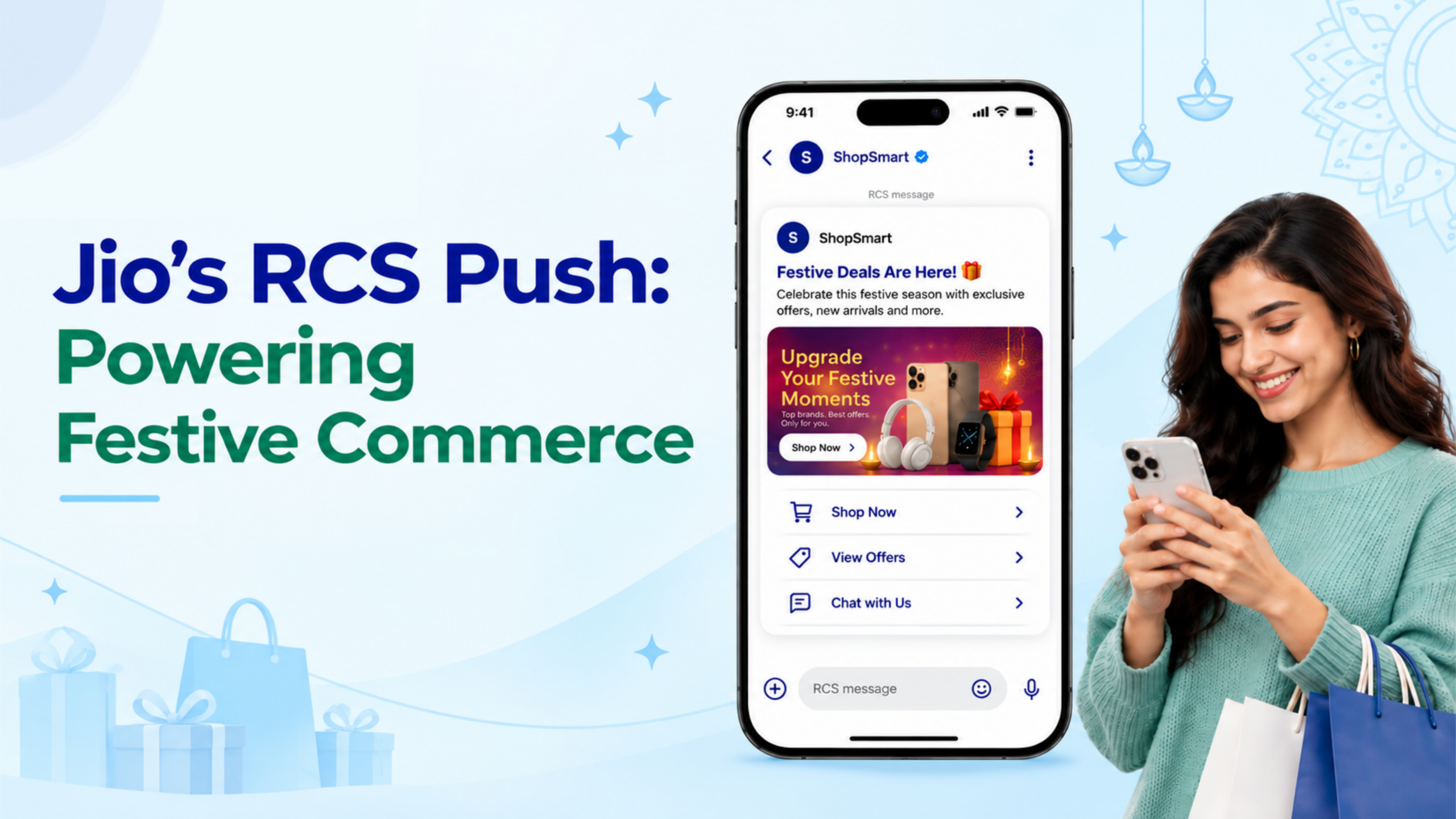
Product Discovery & Promotions: Businesses can use RCS chatbots to showcase products through rich cards, image carousels, pricing details, and action buttons directly within the messaging app. Customers can browse products, view offers, and take actions such as requesting information or making a purchase without leaving the conversation.
While WhatsApp and RCS differ in how they operate, both enable businesses to deliver richer, more seamless customer experiences. Their ability to combine communication, automation, and action within a single conversation is what makes chatbots valuable across marketing, sales, support, and commerce.
Where Chatbots Deliver Value: Use Cases Across WhatsApp and RCS
1. Customer Support
Customer support remains one of the most common and valuable applications of conversational AI. By automating routine interactions, chatbots help businesses provide faster responses, improve customer experiences, and reduce the workload on support teams. They can handle large volumes of queries simultaneously while ensuring customers receive assistance whenever they need it.
- FAQ automation: Chatbots can instantly answer common questions related to pricing, product availability, operating hours, policies, and product information.
- Order and shipment tracking: Customers can check the status of their orders, deliveries, and shipments directly within the conversation without needing to contact a support representative.
- Ticket creation and complaint registration: Chatbots can collect issue details, generate support tickets, and acknowledge customer requests within the chat interface.
- Intelligent escalation: When a query becomes too complex or requires human intervention, the chatbot can seamlessly transfer the conversation to a live agent while retaining the full conversation history and context.
2. Sales Enablement and Lead Qualification
Chatbots have become increasingly important in helping businesses generate, qualify, and convert leads through conversational experiences. Unlike traditional web forms, they create a more interactive journey, allowing businesses to engage prospects in real time while collecting valuable information along the way. As a result, many organisations now view conversational channels as a core part of their lead generation and sales strategy.
- Pre-sales guidance: For high-consideration purchases such as insurance, financial services, or real estate, chatbots can guide potential customers through available options, answer common questions, and gather preferences before a sales representative joins the conversation.
- Visual product discovery: Features such as RCS carousels and WhatsApp catalogues allow businesses to showcase products, pricing, and offers in an interactive, easy-to-browse format directly within the chat experience.
- Lead screening and qualification: Chatbots can collect information such as budget, location, requirements, and purchase intent at scale, helping businesses identify qualified prospects and route them to the appropriate sales teams more efficiently.
3. Marketing and Campaign Execution
Messaging chatbots offer a significant advantage for marketing because they enable brands to engage customers in a direct, personalised, and highly interactive environment. Unlike traditional communication channels, messaging platforms support richer conversations, faster responses, and more seamless customer journeys, making them particularly effective for driving awareness, engagement, and conversions.
- Product launches and promotions: Rich media carousels, images, videos, and interactive content help brands introduce new products and offers in a more engaging and visually compelling way.
- Abandoned cart recovery: Automated workflows can identify customers who leave without completing a purchase and send timely, contextual reminders that encourage them to return and complete the transaction.
- Event invitations and RSVPs: Businesses can use chat-based experiences to invite customers to events, webinars, product launches, or workshops, while allowing recipients to confirm attendance directly within the conversation.
- Personalised engagement campaigns: By leveraging customer preferences, past interactions, and behavioural data, chatbots can deliver more relevant recommendations, offers, and follow-up messages, strengthening customer relationships over time.
4. Transactional Workflows
- Bookings and reservations: Users can schedule appointments, make reservations, and complete purchases directly within the messaging conversation, without being redirected to another platform.
- In-chat payments: Chatbots can generate invoices and facilitate payments within the chat itself, creating a more seamless path from inquiry to transaction.
5. Surveys and Feedback Collection
- Post-interaction surveys: Chatbots can automatically trigger feedback requests after a customer interaction, helping businesses capture opinions and satisfaction levels while the experience is still fresh.
- Interactive polling: Quick-reply polls, surveys, and quizzes make it easier for customers to share preferences and feedback. These interactions provide valuable audience insights that can inform product development, marketing strategies, and future customer engagement initiatives.
Measuring What Matters: KPIs for Chatbot Performance
Four metrics determine whether your WhatsApp or RCS chatbot is delivering real business value.
- Engagement rates: Open rates, reply rates, and CTR are tracked separately by message type. A drop in any one signals a content, timing, or targeting problem.
- Completion rates: The percentage of users who resolve their query without a human handover. Drop-off points in the flow reveal exactly where conversation design is failing.
- Deflection and resolution speed: The proportion of queries resolved without agent involvement, and how fast. Every deflected conversation reduces operational cost directly. Faster response times generally contribute to better customer experiences and higher conversion rates.
- Conversion performance: For lead qualification and transactional flows, track how many users start a flow and finish it. Low completion rates point to friction in the steps, not the channel.
Conclusion
The foundations for conversational engagement are already in place. Customer behaviour has shifted, messaging has become a primary communication channel, and businesses increasingly recognise the value of delivering support, sales, and service through conversational experiences.
The organisations seeing the greatest success are not treating messaging platforms as simple notification channels. Instead, they are using them to create connected customer journeys that bring discovery, engagement, support, and transactions into a single conversation.
As customer expectations continue to evolve, the focus is no longer on whether conversational messaging has a role to play. The real challenge is determining how businesses can use it effectively to deliver faster, more personalised, and more convenient experiences.
The best approach is often the simplest: start with a clear use case, solve a specific customer need, measure the impact, and build from there.