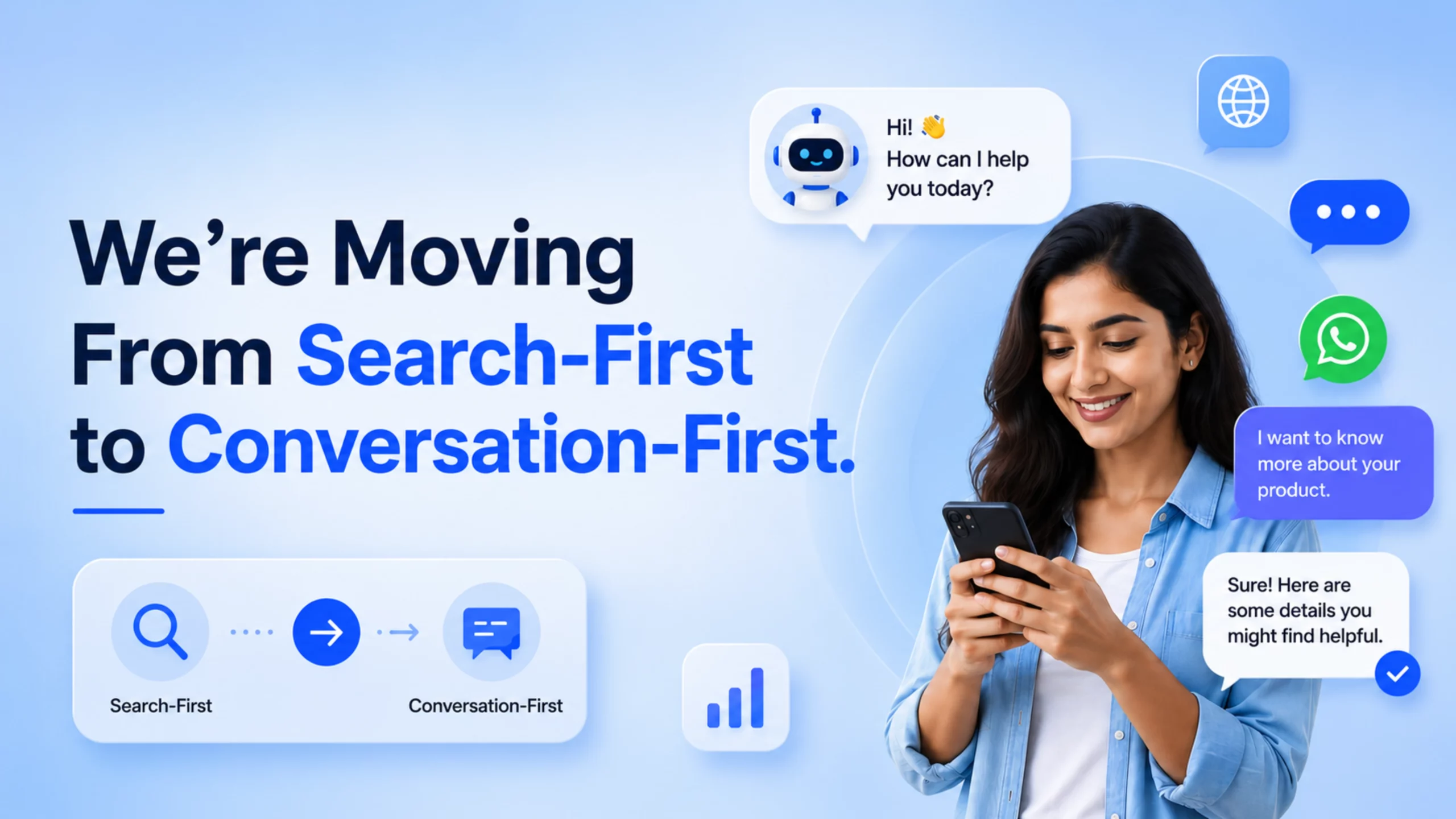
For decades, search engines defined how customers discovered brands online. If someone wanted to buy a product, compare services, or solve a problem, they opened Google, typed a few keywords, and explored a list of results. Brands responded by investing in SEO, paid search, and keyword strategies because ranking higher often meant attracting more customers.
But that behaviour is beginning to change.
Today, consumers are increasingly turning to AI assistants and messaging platforms to ask questions the way they would ask another person. Instead of searching for information, they expect technology to understand context, interpret intent, and deliver the right answer.
This marks one of the biggest shifts in digital behaviour since the rise of search engines themselves. The question for businesses is no longer, “How do we rank higher?” but “How do we become part of the conversation?”
Customers Are Replacing Keywords With Conversations
Traditional search forced people to simplify their needs into a few carefully chosen words.
Someone looking for a new pair of running shoes might search for “best running shoes for beginners” or “running shoes under ₹8,000.” The search engine would then present pages of links, leaving the customer to compare products, read reviews, and piece together the information themselves.
The shift isn’t simply about using AI instead of search engines. It’s about how people express their needs.
As Reem Saied, Co-Founder & CMO at Oogw.ai Analytics, explained during the discussion:
“Before AI came, you would probably search for running shoes. Now you might say, ‘I’m running a marathon, I’m 75 kg, I have flat feet, my budget is ₹4,000. Recommend the ideal shoe for me.’ “
That single sentence perfectly describes how digital discovery worked for years. Customers adapted to the limitations of search engines by thinking in keywords rather than complete thoughts.
Today, that limitation no longer exists.
Instead of reducing their needs to short search queries, customers communicate naturally. They explain their goals, preferences, budget, location, and even previous experiences, expecting AI to understand what they actually mean.
The search bar is gradually becoming a conversation box.
Increasingly, AI is evolving from a tool that simply retrieves information into an assistant that understands context, asks follow-up questions when needed, and can even help users complete tasks. Discovery is becoming less about searching and more about collaborating with AI to reach the right outcome. (Source: Pureinsights)
Search experiences are also evolving to support ongoing conversations rather than one-off queries. Instead of starting over with every search, users can ask follow-up questions, refine their requests, and build on previous context, making information discovery feel more like a continuous dialogue than a series of disconnected searches. (Source: Google)
AI Is Changing How Customers Express Intent
One of the biggest advantages of conversational AI is that it captures intent far better than traditional search ever could.
A keyword can tell you what someone is looking for.
A conversation tells you why.
This shift is possible because modern AI doesn’t simply match keywords. It interprets intent, context, and the meaning behind a customer’s request, allowing it to deliver recommendations that feel significantly more relevant than traditional search ever could. (Source: Pureinsights)
That’s an important difference.
Someone shopping for a laptop isn’t simply looking for a device. They may be a university student looking for affordability, a graphic designer needing high processing power, or a remote professional prioritising battery life. Those details completely change what the right recommendation looks like.
That is exactly how customers are beginning to interact with AI assistants today. Rather than entering fragmented keywords, they explain the entire context behind their decision.
For brands, this creates an opportunity to understand customers on a much deeper level.
Instead of responding to isolated search terms, businesses can respond to genuine customer intent, delivering recommendations that feel personalised rather than generic.
Conversational Commerce Is Becoming the New Storefront
The shift towards conversations is transforming not only how customers discover products but also how they buy them.
Increasingly, people expect to ask questions, compare products, receive recommendations, complete payments, and access customer support without switching between multiple websites or apps.
This is the foundation of conversational commerce.
Messaging platforms such as WhatsApp are no longer just communication tools. They are becoming complete customer engagement channels in which discovery, purchase, and support occur within a single, continuous interaction.
As Akhil Ramundla, Co-Founder & CMO at XYXX, observed during the discussion, “WhatsApp, for me, apart from being a conversion lever, is also a natural lever for reducing friction in the customer journey.” He pointed to features such as product discovery, abandoned cart recovery, and personalised recommendations as examples of how conversations are increasingly replacing fragmented customer journeys.
The next evolution goes beyond answering questions. AI assistants are increasingly performing tasks on a customer’s behalf, from monitoring information and comparing options to booking services or completing purchases. As AI becomes more action-oriented, conversations won’t just influence buying decisions—they’ll increasingly help complete them. (Source: Google)
The experience feels significantly more natural.
Instead of navigating menus and forms, customers simply continue the conversation.
This reduces friction throughout the buying journey while creating opportunities for businesses to provide personalised assistance at every stage.
Rather than acting as separate functions, marketing, sales, and customer support become part of one seamless customer experience.
AI Assistants Are Becoming the First Point of Discovery
Perhaps the most significant consequence of this shift is that a brand’s first interaction with a customer may no longer happen on its own website.
Instead, it may happen through an AI assistant.
Whether someone is using ChatGPT, Gemini, Meta AI, or AI integrated into messaging platforms, customers increasingly begin their buying journey by asking questions.
They ask for recommendations.
They compare products.
They request summaries of reviews.
They seek personalised advice before ever visiting a brand directly.
As these interactions become more common, businesses are competing for something entirely different.
They’re no longer competing only for search rankings.
They’re competing to become the recommendation that AI delivers.
Unlike traditional search, where customers compared multiple websites before making a decision, AI assistants increasingly synthesise information into a single recommendation or answer. As a result, brands are no longer competing simply to appear in search results—they’re competing to become one of the trusted sources AI systems choose to reference. (Source: alf)
Customers Want Answers, Not Search Results
Customer expectations are evolving just as quickly as the technology itself.
People no longer want to spend time opening multiple tabs, comparing dozens of articles, or filtering through pages of search results to make a decision.
They expect businesses to provide clarity. This shift isn’t only changing how people search. It’s changing what they expect in return.
AI has changed customer expectations. People no longer want a page of links, they expect brands and AI assistants to interpret their intent and recommend the best solution immediately.
It influences every customer interaction, whether someone is chatting with a business on WhatsApp, browsing a website, or asking questions through a virtual assistant.
Customers increasingly expect brands to understand context, anticipate follow-up questions, and provide complete, relevant responses without forcing them to repeat information or search elsewhere.
The quality of the answer is becoming just as important as the quality of the product.
Optimising for Conversations Instead of Keywords
SEO isn’t disappearing.
Search engines will continue to play an important role in how customers discover businesses. But keywords alone are no longer enough to meet changing customer expectations.
Brands now need to optimise for conversations.
Akhil also argued that brands need to train AI on more than conversion metrics. “Train your AI to go beyond conversion. Look for what the brand stands for, what is its purpose, what is its voice, what is its personality.” In other words, AI shouldn’t simply recommend products; it should recommend them in a way that reflects the brand customers are meant to experience.
That means creating content that answers real customer questions rather than simply targeting high-volume search terms. It also means anticipating the follow-up questions customers are likely to ask, providing clear, contextual answers that help them move naturally from discovery to decision. It means ensuring AI assistants can understand product information, brand messaging, and customer support content. And it means designing experiences where customers can ask detailed questions, receive personalised guidance, and complete their journey with minimal friction.
In many ways, conversational experiences are becoming the next evolution of customer experience.
The businesses that succeed won’t simply have the best websites.
They’ll have the most helpful conversations.
The Future Belongs to Brands That Can Hold Better Conversations
Every major shift in technology changes how customers discover businesses.
Search engines reshaped the internet by organising information.
Conversational AI is reshaping it by organising understanding.
Customers no longer think in keywords because they no longer have to. They think in problems, situations, and goals—and they expect businesses to respond in the same way.
For brands, this requires a shift in mindset.
Visibility will increasingly depend not just on being searchable, but on being understandable. Success will come from building experiences that recognise customer intent, provide meaningful answers, and create seamless conversations across AI assistants, messaging platforms, and every digital touchpoint.
The future of customer engagement won’t be won by the brands with the longest keyword lists.
It will belong to the brands that become part of the conversation.