
The festive season brings a sharp rise in customer activity. Brands launch new collections, announce offers, send reminders, and manage a surge in orders and customer queries, all while competing for customer attention. But one aspect of festive marketing is often overlooked: not every customer interaction needs the same kind of communication.
Festive shopping journeys are becoming less linear, with consumers discovering products and researching purchases across multiple digital touchpoints before making a decision. This makes it important for brands to consider how their communication channels support different stages of the customer journey.
A product discovery message serves a different purpose from an OTP. A customer asking about a product needs a different experience from someone waiting for a delivery update. Yet, brands often treat WhatsApp, RCS, and SMS as interchangeable customer communication channels.
A better approach is to start with the customer’s need and then choose the channel that best fits that moment.
One Festive Journey, Different Communication Needs
A customer might discover a festive collection through a rich message, move to WhatsApp to ask a question, receive an OTP while completing the purchase, and get an SMS when the order is dispatched. The customer does not think of these as four different communication strategies. They experience them as different moments in their journey with the same brand. This makes channel selection less about finding the ‘best’ platform and more about understanding what the customer needs at each stage.
The same principle applies to the communication channels themselves. Each channel has a defined role within the larger festive strategy, rather than every platform being expected to do the same job. (Source: Media Brief)
WhatsApp Marketing: When the Customer Needs a Conversation
Festive shopping often brings questions. Is the product available? Which size is right? Can it be delivered before Diwali? Does a particular offer apply? Can the customer see more options? These are moments when a one-way message may not be enough. The customer needs the ability to ask, respond, and explore.
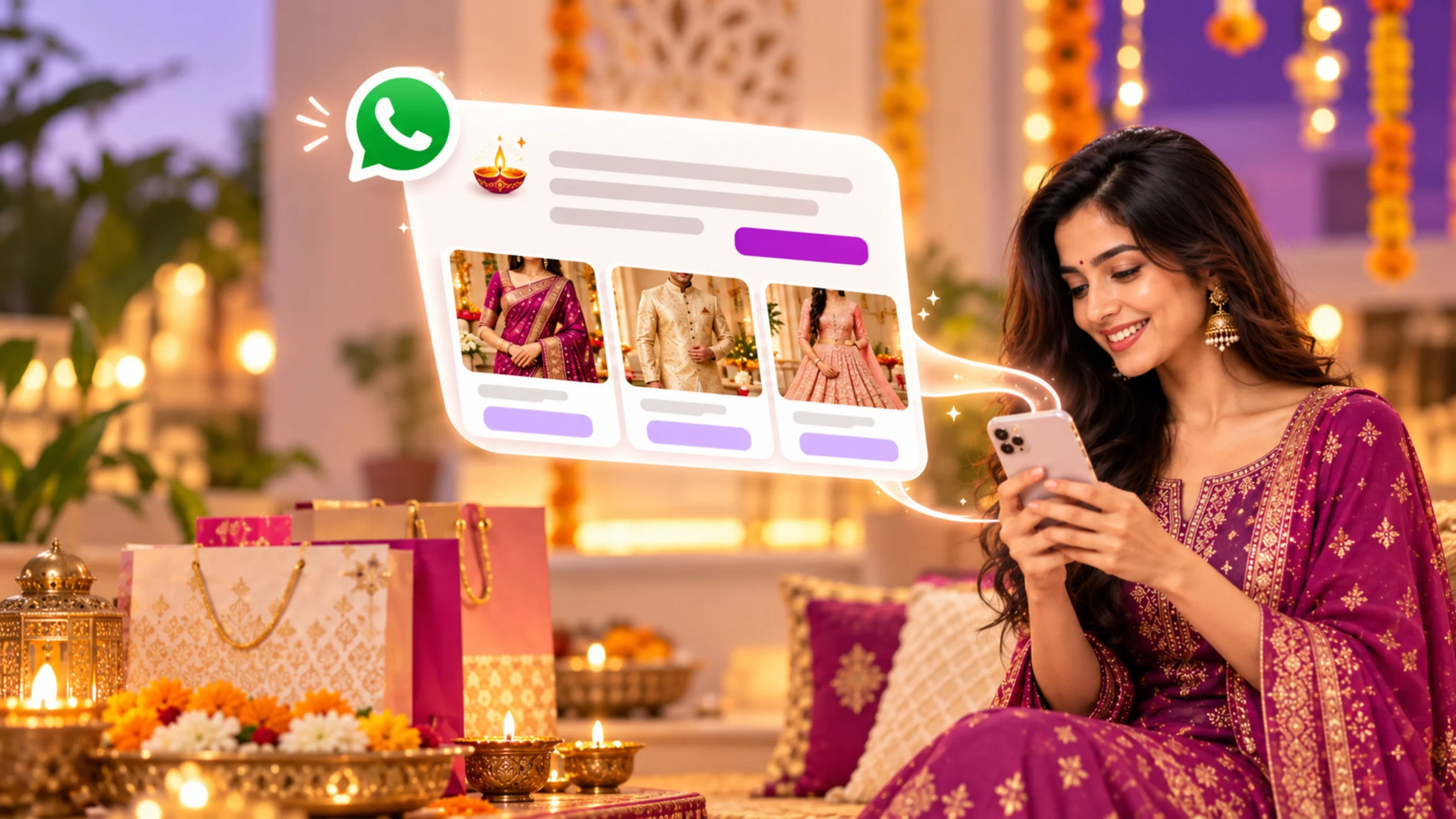
WhatsApp marketing can be particularly useful here because it supports conversational experiences around product discovery, customer queries, catalogues, order-related interactions, and commerce.
For example:
🪔 Looking for your Diwali outfit?
Explore our festive collection, find your size, and chat with us if you need help choosing.
[View Collection] [Chat With Us]
The point is not simply to send customers a catalogue. It is to give them a way to move from interest to interaction without unnecessary friction.
This can also influence purchase decisions. According to Kantar research commissioned by Meta, 72.4% of consumers surveyed across 22 markets are more likely to purchase from a brand that offers messaging. During the festive season, this makes conversational communication a useful way to help customers resolve questions as they consider a purchase. (Source: WhatsApp Business)
RCS Messaging: When the Experience Needs to Be More Visual
Some festive messages are inherently visual. A fashion brand may want to showcase a collection. An electronics retailer may want to put several products in front of a customer. A travel company may want to highlight festive packages. In such cases, plain text may communicate the offer without fully communicating the experience.
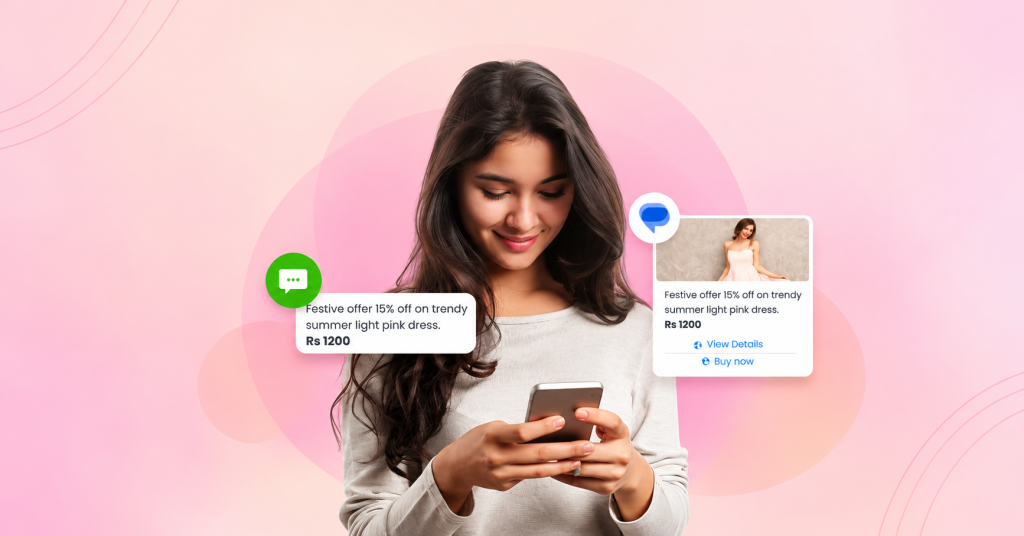
RCS messaging can bring richer formats such as images, carousels, buttons, and actionable CTAs into the messaging experience. For brands planning their festive marketing strategy, this creates another option for showcasing products and making the next step clear within the message itself.
For example:
✨ Your festive shopping starts here
Explore our Diwali favourites, from ethnic wear to festive accessories.
[Shop Sarees] [Shop Kurtas] [View All]
The value of RCS is not simply that it makes a message look richer. It can make product discovery and the next action clearer within the message itself.
SMS Marketing: When the Customer Needs a Clear, Timely Message
SMS marketing also has a role in the festive shopping journey, particularly when customers need essential information delivered clearly and promptly. From checkout verification to delivery notifications, SMS can communicate time-sensitive updates without requiring customers to navigate an additional interaction.
During the festive rush, these messages become particularly important because delays or missed information can interrupt an otherwise smooth purchase journey.
For example:
Your Diwali order #45821 has been shipped. Expected delivery: 27 October. Track your order: [link]
Here, simplicity is an advantage. SMS remains useful when customers need time-sensitive updates or essential information without additional steps.
One Festive Journey, Multiple Channels
A festive shopping journey rarely depends on just one type of communication. A customer might discover a collection through RCS, turn to WhatsApp to ask a product-related question, and receive an SMS with an order update. Each channel serves a different purpose, but together, they contribute to the overall customer experience.
This connection matters because customers experience a brand across multiple touchpoints, not as a series of separate campaigns. When communication remains relevant and consistent as customers move from product discovery to purchase and post-purchase updates, each interaction can support the next stage of their journey. (Source: WhatsApp Business)
| Customer need | Channel that can fit |
| Discover a festive collection visually | RCS |
| Explore products or ask questions | |
| Complete verification during checkout | SMS |
| Receive a payment or order update | SMS |
| Re-engage customers with an interactive offer | WhatsApp / RCS |
This is where an omnichannel marketing approach becomes relevant. The goal is not simply to use multiple customer communication channels, but to ensure each message reaches customers through a channel that suits their needs and fits into the larger shopping journey.
This does not mean creating completely separate communication for every channel. The broader festive message can remain consistent, while the format, level of detail and call to action are adapted to the channel and the customer’s immediate need. (Source: Media Brief)
For businesses developing an omnichannel marketing strategy, the focus should be on how these interactions work together rather than treating every channel as a separate campaign.
More Messages Do Not Mean Better Communication
Festive shoppers already have plenty of messages competing for their attention. More campaigns do not necessarily create more engagement. What matters is relevance.
Nitya Mohan of The Tribe Concepts highlights why relevance matters more than reach alone:
“Reaching customers with the right message is what matters. Without the right message and context, reach is just noise. Reaching the right customers with the right message is what drives conversions.”
This is especially important during the festive season, when customers move through different stages of the shopping journey. Someone browsing a collection may appreciate seeing products in a visual format. A customer with a question may value a conversation. Someone waiting for an OTP or delivery update simply wants the information quickly.
The communication channel should reflect that difference. For businesses working with communication platforms such as TrustSignal, this means looking beyond individual channels and considering how WhatsApp, RCS and SMS can work together to support different stages of the customer journey.
A successful festive marketing strategy does not depend on finding one winning communication channel. It depends on choosing the channel that makes sense for the moment. When communication reflects what customers need, it becomes a useful part of the shopping experience rather than just another marketing message.