
For Indian brands, the festive season is no longer just a period of higher sales. It is also a period of higher communication. From announcing early-bird offers and sharing product recommendations to sending payment confirmations, order updates and delivery alerts, brands need to stay connected with customers across multiple moments of the purchase journey.
That makes the latest development in business messaging particularly timely. Reliance Jio has introduced business RCS messaging for iPhone users in India following its partnership with Apple, opening up application-to-person messaging on iOS devices connected to the Jio network. Businesses can now use RCS Business Messaging for marketing, transactional, and OTP communication, with Jio introducing separate pricing categories for each.
The timing matters. With the festive shopping season approaching, brands are entering a period when customer attention is at a premium. And RCS gives them another way to make that attention count.
The scale of that opportunity is significant. According to Datum Intelligence’s Festive Barometer 2026, India’s festive e-commerce sales are expected to grow 25–29% this season and cross ₹1.5 lakh crore, with much of that growth driven by more shoppers placing more frequent orders. (Source: Datum)
More importantly, higher-order volumes create more opportunities for communication. Every order confirmation, payment update, delivery alert, and promotional reminder becomes another opportunity for brands to either build confidence or lose attention.
That momentum sits within a broader expansion of online commerce. According to the India Brand Equity Foundation (IBEF), India’s online retail market reached approximately US$80 billion in FY26, growing 21% year on year, driven in part by quick commerce and rising digital adoption beyond major cities. (Source: IBEF)
As shopping becomes more digital, the expectation for communication changes too. Customers increasingly expect updates to arrive quickly, look trustworthy, and make it easy to take the next step without switching between multiple apps. That makes timely, relevant customer communication even more important as brands compete across every stage of the purchase journey.
RCS is moving beyond Android
RCS has long been positioned as the richer successor to SMS, bringing rich communication features such as images, carousels, suggested replies, action buttons, verified sender profiles, and other interactive elements into the native messaging experience.
What changes with Apple’s involvement is reach. For years, one of RCS’s biggest limitations was that its richer experience was associated largely with Android users. As support expands across more devices and operators, that limitation begins to matter less, giving businesses a more practical reason to include RCS in broader messaging plans.
Jio says its RCS messaging service, powered through partnerships with Google and Apple, can bring branded RCS experiences to both Android and iOS users on its network. Customers can receive rich business messages directly in their native messaging inbox without having to download another application.
For businesses, that makes the RCS service more interesting as a complement to channels such as WhatsApp and SMS. Instead of thinking about messaging as a single-channel decision, brands can begin thinking about which channel works best for which customer and at which moment.
This shift is part of a broader change in the RCS for Business market. Juniper Research identifies Apple’s ongoing rollout of RCS for Business on iPhones as one of the key drivers shaping the market in 2026, alongside growing support from mobile operators and the expansion of third-party verification authorities. (Source: Juniper Research)
That broader momentum matters because businesses rarely adopt a channel based on one launch announcement alone. They adopt it when the surrounding ecosystem—devices, operators, and messaging standards—starts moving in the same direction.
RCS is also strengthening its foundations around security and interoperability. The GSMA’s RCS Universal Profile 4.1 refines its end-to-end encryption specifications to improve how encrypted messages work across different messaging clients and services. For businesses, that points to a messaging ecosystem that is not only richer but also becoming more consistent and secure across networks and devices. (Source: GSMA)
And that distinction could become increasingly important as more telecom operators enter the ecosystem. Airtel and Vodafone Idea are expected to onboard Apple’s RCS ecosystem as well, according to The Economic Times. (Source: The Economic Times) In other words, the RCS market is beginning to look less like a single-platform proposition and more like a competitive messaging ecosystem.
Why this matters for the festive season
Festive commerce is built around moments. A customer sees a Diwali offer, explores a product, receives a reminder, completes the purchase, and waits for delivery. Each interaction is an opportunity for a brand to either add value or become another notification competing for attention. The difference often comes down to whether each message feels like progress in the customer’s journey rather than another interruption. During festive campaigns, where purchase decisions can stretch across days or even weeks, that distinction becomes even more valuable.
That question of relevance becomes even more important when customers are already receiving a high volume of festive messages. Jermy T. of Supertails put it simply: “It is okay to have 10 messages coming to the customer. But why does that message make sense to the customer?” The point is not simply to reduce message volume, but to give each communication a clear reason to be noticed. His example captures the idea well: “If I am looking for this product, then tell me about this product.” In that sense, personalisation works best when it is grounded in relevance—giving customers a message that connects with what they actually need or are interested in.
Festive shopping journeys are also becoming less linear. Research has found that only 58% of shoppers purchase on the same device where they first discover a product, while 32% switch devices during the journey. For brands, that makes consistent communication across discovery, consideration, and purchase increasingly important. (Source: M&C Saachi Performance) It also reinforces why a single channel is rarely enough. Customers may discover a product in one place, continue browsing somewhere else, and still expect a seamless experience when it’s time to buy.
This shift is also being reinforced by quick commerce, which has made high-frequency, convenience-led shopping a larger part of India’s digital retail landscape. The segment was already estimated at US$7–8 billion in FY25 and is projected to reach US$65–70 billion by 2030, signalling how quickly shopping behaviour is moving towards more frequent, convenience-driven purchases. (Source: IBEF)
Even as smartphone prices have risen, financing has helped keep devices within reach for many consumers. Counterpoint Research found that smartphone financing accounted for more than half of mainline smartphone sales in India in Q2 2026, helping make devices more accessible even as rising component costs pushed prices higher. (Source: Counterpoint)
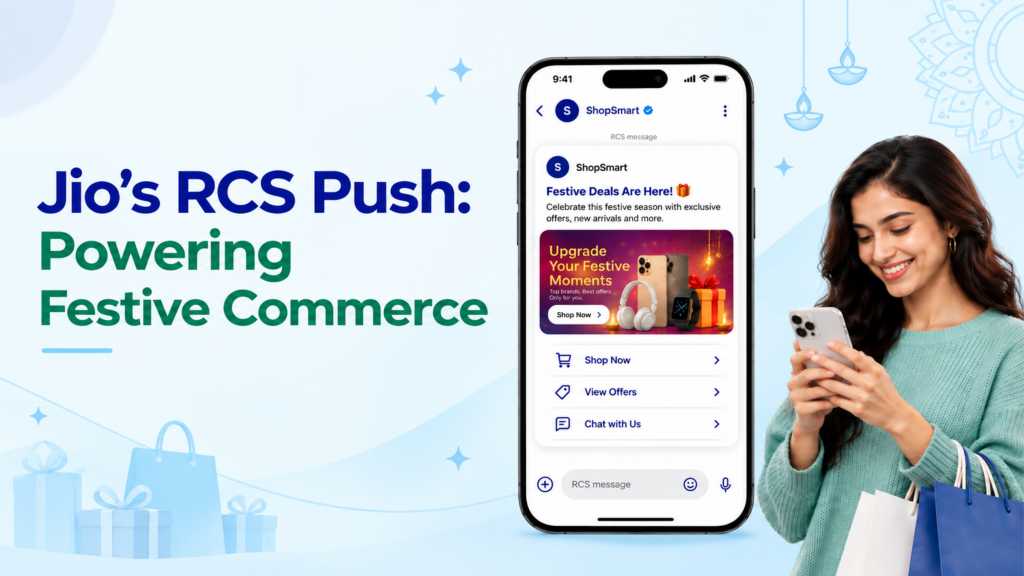
RCS can make some of those interactions more visual and actionable. Instead of treating messaging as a one-way notification, brands can use it as a continuation of the shopping experience itself. The richer format makes it easier to show products, reduce unnecessary steps, and encourage action within the conversation.
A fashion brand, for example, could use a rich card to showcase a festive collection and include a direct shopping action. A beauty brand could present multiple gift sets through a carousel. A retailer could send a personalised offer followed by a quick-reply option. Transactional communication can also become more useful when customers receive branded order confirmations, delivery updates, or payment-related messages.
JioCX’s RCS offering highlights capabilities such as rich media, interactive buttons, verified Agent IDs, and analytics designed to help businesses measure delivery and engagement. The opportunity, therefore, is not simply to send a more attractive message. It is to reduce the distance between seeing an offer and acting on it.
The smart move is not to replace WhatsApp
The rise of RCS does not mean brands should suddenly move their messaging strategy away from WhatsApp. If anything, the development reinforces a larger shift in customer communication: brands need more than one strong messaging channel.
WhatsApp remains deeply embedded in customer engagement, while SMS continues to play an important role in reach, alerts, and authentication. RCS adds another layer, particularly for brands looking to bring rich messaging experiences into the native messaging environment.
The real opportunity lies in orchestration. Different moments call for different strengths. A customer asking a question about an order may prefer a conversational experience, while a limited-time festive offer or a branded delivery update may benefit from a richer visual format inside the native messaging inbox.
A brand could use WhatsApp for conversational journeys, RCS for rich promotional and transactional experiences, and SMS for situations where broad reach or fallback communication is important. The objective is not to choose a winner between channels, but to understand where each one creates the most value.
How brands can make RCS work this festive season
The arrival of RCS-enabled iPhones on Jio’s network gives marketers another RCS messaging service to experiment with, but the technology itself will not determine campaign success. The strategy will. The strongest festive campaigns rarely rely on a single message.
They build momentum across multiple touchpoints, making each interaction feel relevant to where the customer is in the buying journey. RCS becomes most useful when it supports that progression rather than trying to replace every other channel.
- Start with high-intent use cases: Festive campaigns should focus on moments when richer communication can drive action: product discovery, limited-time offers, cart reminders, order updates, and post-purchase engagement.
- Design for interaction, not just visibility: RCS messages should give customers something to do. Carousels, quick replies, and action buttons can help move customers from browsing to buying without adding unnecessary steps.
- Use the visual format purposefully: Festive communication naturally lends itself to visual storytelling, but brands should avoid filling every message with images and offers. The creative should make the next action obvious.
- Segment before sending: A customer who has already purchased a festive gift does not need the same message as someone who has only browsed a product category. RCS can become more effective when rich experiences are paired with relevant customer data and segmentation.
- Measure the complete journey: Open and click metrics are useful, but brands should ultimately connect messaging performance with business outcomes such as product views, conversions, repeat purchases, and revenue.
The bigger shift is happening across the messaging market
Jio’s move is important, but the larger story is the market forming around it. Apple and Google bring the technology layer. Telecom operators bring network access. Messaging platforms bring established customer behaviour. And businesses bring the demand for richer, measurable communication. With more operators expected to participate, the competitive landscape could become considerably more interesting over the coming months. For brands, that means the question is no longer simply whether RCS will compete with WhatsApp. The more important question is: how should businesses build a messaging strategy when customers can be reached through multiple rich, interactive channels?
That makes the current season more than a test of a new messaging format. It is an early look at how brands may start combining richer messaging, native mobile experiences, and multi-channel communication into a more connected customer journey. As customer journeys become increasingly conversational, the brands that perform best may not be the ones sending the most messages. They will be the ones choosing the right channel, format, and moment to make each interaction count.