

For years, businesses viewed WhatsApp as a customer support channel.
A customer had a question, raised a ticket, received a response, and the conversation ended there.
That role has changed dramatically.
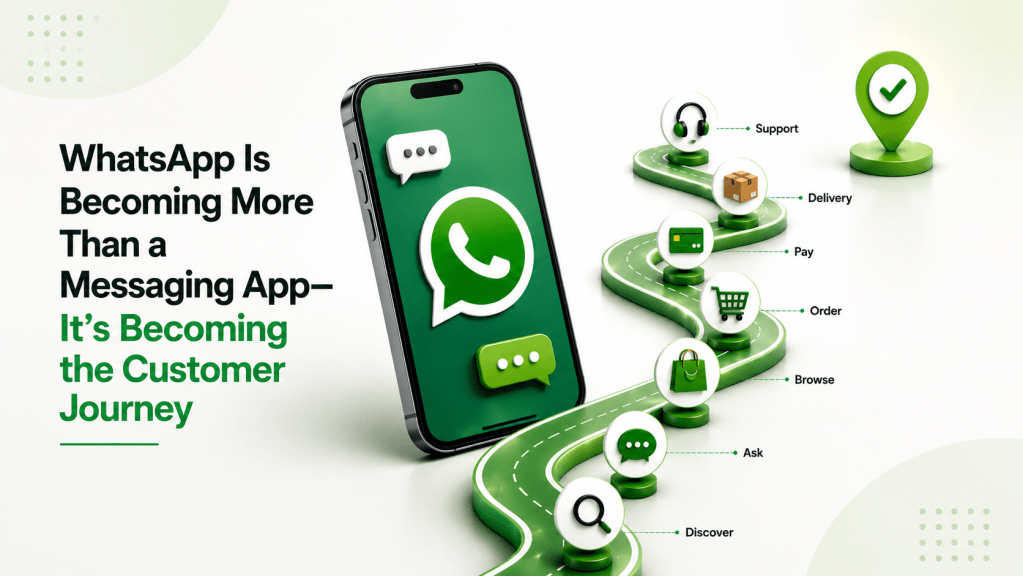
Today, the same conversation can begin with a click on an advertisement, continue through product discovery, answer questions in real time, verify customer identity, complete a purchase, and even provide post-sale support. What was once a messaging app is steadily becoming the platform where much of the customer journey takes place.
This shift reflects a larger change in consumer behaviour. Customers no longer want to move between websites, apps, emails, and support portals to accomplish a single task. They expect businesses to meet them where they already spend their time and help them complete tasks with as little effort as possible.
As Mr. Akhil Rumandia, Business Head – D2C at XYXX, puts it:
“The way I see it, WhatsApp is much more than a conversion lever. It’s a natural way to reduce friction throughout the customer journey.”
That observation captures why conversational commerce is becoming one of the biggest opportunities for businesses today. The value of WhatsApp no longer lies in messaging alone—it lies in making every stage of the customer journey simpler, faster, and more connected.
The Customer Journey Is Becoming a Conversation
For decades, businesses designed customer journeys as a series of separate steps.
A customer might discover a product through an advertisement, visit a website to learn more, create an account, complete a purchase on another platform, contact support through email,l and receive updates through SMS.
Each interaction required switching channels.
Every additional step created another opportunity for customers to lose interest or abandon the journey altogether.
WhatsApp changes that model.
Instead of moving customers across multiple touchpoints, businesses can guide them through discovery, engagement, purchasing, and support within one continuous conversation.
The result is not simply greater convenience. It is a customer experience with significantly less friction. Leading CX research by Gartner emphasizes that effective customer journey management requires orchestrating interactions across channels and touchpoints as a single, coherent experience, rather than siloed steps—precisely the kind of continuity that messaging-first journeys can deliver. When customers can ask, decide, pay, and get help in a single thread, the journey stops feeling like a sequence of tasks and starts to feel like a natural dialogue. (Source: Gartner)
CTWA Is Redefining Customer Acquisition
One of the clearest examples of this shift is Click-to-WhatsApp Ads (CTWA).
For years, digital advertising followed a familiar path. A customer clicked an ad, landed on a website, browsed through products and, if everything aligned, eventually made a purchase. Every additional step, however, introduced more friction and another opportunity for the customer to drop off.
CTWA is changing that journey.
Instead of sending customers to a landing page, businesses can begin a conversation the moment someone expresses interest. Questions can be answered instantly, recommendations can be personalised, and purchase intent can be understood in real time—all within a familiar messaging environment.
More importantly, it changes how brands think about customer acquisition itself.
Success is no longer measured solely by the number of clicks an ad receives. Increasingly, it’s about the quality of the conversations that follow. A conversation reveals intent, uncovers hesitation, and provides context that a website visit alone rarely can.
This is why conversational commerce is gaining momentum. As McKinsey notes, messaging platforms are becoming the entry point to the buying journey, bringing together product discovery, customer service, and transactions into a single, continuous experience. Rather than treating acquisition and engagement as separate stages, businesses can now build relationships from the very first interaction. (Source: McKinsey&Company)
But the value of those conversations doesn’t end with conversion. Every interaction also gives businesses something traditional digital channels rarely could: a deeper understanding of customer behaviour.
That is where conversational commerce becomes more than a sales channel. It becomes a source of customer intelligence.
Conversations Are Becoming a Source of Customer Intelligence
Clicks tell businesses what customers selected.
Conversations explain why they selected it.
A customer asking whether a product suits sensitive skin, requesting a different colour, or comparing two subscription plans provides context that behavioural analytics alone cannot capture.
This creates a richer understanding of customer intent.
Businesses begin to recognise recurring objections, common questions, purchase triggers and decision-making patterns that can improve not only sales conversations but also product development, marketing campaigns and customer support.
In many ways, conversational data is becoming one of the most valuable forms of first-party customer insight. As AI becomes increasingly embedded into customer experiences, the quality of that data will play a defining role in how effectively businesses can personalise interactions and automate decision-making.
As Reem Saied, Co-Founder & CMO at Oogw.ai Analytics, explains:
“Your AI is only as good as the data you feed it. Start with your own enterprise data. Just as first-party data is more valuable than cold outreach in marketing, your enterprise data should be the foundation of every AI strategy.”
When conversations become part of an organisation’s enterprise data, they do more than improve individual interactions. They create a continuously growing knowledge base that enables AI to deliver more relevant recommendations, faster support, and increasingly contextual customer experiences.
Product Discovery Is Becoming Personal
Product discovery has traditionally depended on website navigation, search bars, and recommendation engines.
Conversational commerce introduces a different experience.
Instead of browsing endless catalogues, customers can describe what they need in their own words and receive relevant recommendations instantly.
Someone looking for skincare products can explain their skin concerns. A traveller can ask about available plans. A banking customer can enquire about financial products. The interaction becomes dynamic rather than transactional.
This makes product discovery feel less like searching through a catalogue and more like speaking to a knowledgeable store assistant.
As AI becomes increasingly integrated into WhatsApp experiences, these recommendations will become faster, more personalised, and increasingly contextual.
The same conversation doesn’t have to end once a customer discovers the right product. Increasingly, it continues well beyond the point of purchase.
Customer Support Is No Longer the End of the Journey
Businesses have traditionally viewed customer support as something that happens after a purchase.
Conversational commerce challenges that assumption.
Support can begin before customers make a decision, continue during onboarding, and remain available throughout the relationship.
As Mr. Suresh Nemani, Senior Vice President at Sushil Finance, points out:
“WhatsApp is all about speed. Whether the information is critical or routine, what matters is how quickly and easily you can deliver it to customers.”
Questions about pricing, delivery timelines, product compatibility or returns can all be answered within the same conversation. Rather than operating as isolated departments, sales, marketing and support begin to function as one continuous customer experience.
This creates stronger relationships while reducing the effort customers need to invest in getting answers.
But convenience alone isn’t enough. As more customer interactions move into messaging platforms, businesses also have to ensure those experiences are secure and trustworthy.
Trust Will Become Just as Important as Convenience
As more customer journeys move to messaging platforms, trust becomes increasingly important.
Customers are more willing to share information and complete transactions when they know they are interacting with a verified business.
Consent also becomes essential.
Conversational commerce is not about sending more messages. It is about creating relevant conversations that customers have chosen to participate in.
Businesses that respect customer preferences, communicate transparently and obtain consent before engagement are far more likely to build lasting relationships.
The same principle applies to KYC.
Identity verification has traditionally involved lengthy forms, document uploads and repeated verification requests. Increasingly, businesses are exploring conversational journeys that simplify these processes while maintaining compliance and security.
The easier businesses make secure interactions, the more confidence customers develop in digital experiences.
Once customers trust a channel, they’re far more likely to return to it. That changes how businesses think about engagement itself.
Engagement Is Becoming Continuous
Perhaps the biggest change is how businesses define customer engagement. Previously, engagement ended once a campaign finished or a purchase was completed. Conversational commerce replaces isolated campaigns with ongoing relationships.
Customers can return to previous conversations, ask new questions, receive relevant updates, and continue engaging with businesses without having to start from scratch. Every interaction adds context for future conversations, making experiences increasingly personalised over time.
The conversation itself becomes the relationship.
The Future Belongs to Businesses That Design Conversations
The next generation of digital experiences will not be defined by websites alone or even by mobile apps.
Rumandia believes:
“From a future perspective, conversations are going to become much bigger. Millions of users are still not comfortable browsing the internet the traditional way. Conversational experiences can bridge that gap while giving businesses valuable signals to better understand customer intent.”
They will be defined by conversations.
Businesses that continue treating WhatsApp service as simply another messaging channel risk missing its larger potential.
The platform is evolving into an ecosystem where discovery, engagement, verification, customer support, and commerce come together in one seamless journey.
The organisations that succeed will not necessarily be those that send the most messages. They will be the ones who design the most meaningful conversations.
Because the future of WhatsApp isn’t messaging.
It’s the customer journey.