

From Raksha Bandhan and Janmashtami to Navratri, Diwali, Christmas and New Year’s Eve, customers move through a succession of gifting, celebration and shopping moments. Occasions such as Karva Chauth and the wedding season add another layer of demand for categories such as fashion, jewellery, and beauty.
For brands, this creates an interesting challenge. The customer may be using the same WhatsApp account throughout the season, but the reason they are shopping keeps changing.
A customer may discover a festive outfit on Instagram, ask a friend about it on WhatsApp, check the price while travelling, and place the order that same evening. For brands, this means the distance between marketing and commerce is becoming increasingly small.
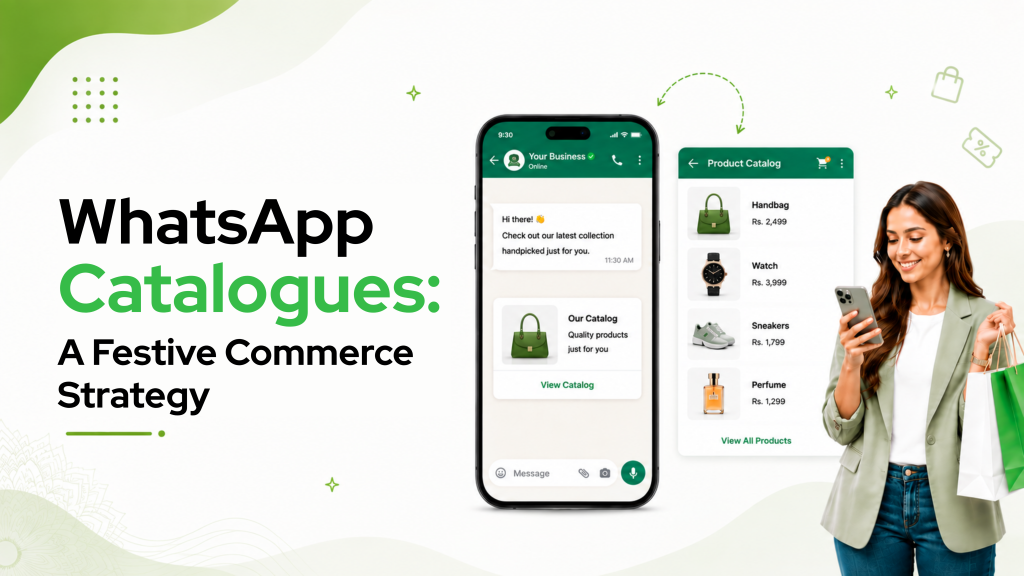
This is where WhatsApp catalogues are becoming more than a digital product list. During high-intent periods across India’s festive and celebration calendar, they can become a simple storefront that helps customers browse, compare, and start a conversation without leaving a platform they already use every day.
The broader conversational commerce market is moving in the same direction. Future Market Insights projects India to be the fastest-growing country in the market, with a 17.8% CAGR through 2036, as mobile payments and messaging increasingly converge around chat-led purchasing. (Source: Future Market Insights)
For businesses, the opportunity is not simply to put more products on WhatsApp. It is to make the path to purchase easier.
A WhatsApp Catalogue is More Than a Product Display
At its simplest, a WhatsApp Business catalogue allows a business to showcase products with images, descriptions, prices, and other relevant information. Instead of sending individual photographs whenever a customer asks, businesses can give them one place to browse.
That small change can have a meaningful impact on the customer experience.
Think about the traditional WhatsApp shopping journey. A customer asks for a product. The business sends a photograph. The customer asks for the price. Another message follows. Then comes a question about colour, size, or availability. More photographs are exchanged. The customer may eventually buy, but the process becomes dependent on several back-and-forth conversations.
A WhatsApp product catalogue can remove much of that friction by putting the basic information in front of the customer from the beginning.
The strategic lesson is simple: customers do not necessarily need more communication; they need better-organised communication.
Why the Festive Season Makes Catalogues More Important
Festive shopping creates a different kind of demand. Customers are often browsing multiple categories at once, looking for gifts, comparing offers, and making decisions closer to the occasion.
For brands, that creates both an opportunity and a problem.
There is more consumer intent, but there is also more competition for attention. Every brand is pushing festive offers across advertising, social media, email, and messaging channels. Sending another promotional message is therefore not enough.
This is where a WhatsApp catalogue can play a different role.
Instead of using WhatsApp only to announce a discount, brands can use it to move customers from the announcement to the actual shopping experience. A festive message can introduce a collection, while the catalogue gives customers somewhere to explore it.
For example, a fashion brand could promote a “Festive Edit”, a jewellery business could create a gifting collection, and a beauty brand could organise products into festive gift sets.
The catalogue becomes the bridge between festive marketing on WhatsApp and commerce.
That shift is part of a broader change in how commerce is taking place. Mordor Intelligence estimates that retail and e-commerce accounted for 27.84% of the conversational commerce market in 2025, underscoring how closely conversational experiences are becoming tied to the buying journey. The implication for brands is less about WhatsApp alone and more about bringing the shopping journey closer to the conversation itself. (Source: Mordor Intelligence)
The Best Festive Catalogues are Curated, Not Crowded
One of the biggest mistakes businesses can make is treating a festive catalogue like a warehouse.
More products do not automatically mean more sales. During a busy shopping period, an oversized catalogue can make decision-making harder.
That matters as Indian consumers become more deliberate about where they spend, making relevance and value increasingly important during high-intent shopping periods. Deloitte’s October 2025 Consumer Signals report found that discretionary spending in India was recovering year-on-year, while remaining below its baseline, pointing to a more value-conscious approach to consumption. At the same time, 59% of consumers said they could afford to spend on things that bring them joy. (Source: Deloitte)
A better approach is curation.
A WhatsApp catalogue for festive sales should reflect how customers actually shop. Categories such as “Gifts Under ₹999”, “Diwali Essentials”, “Wedding Guest Edit” or “Festive Gifts for Families” can help customers reach relevant products faster.
The principle is similar to a good physical store. During a festive period, a retailer does not necessarily put every product at the entrance. It highlights the products most relevant to the season.
The same thinking should apply digitally.
Brands should prioritise products that are in stock, easy to fulfil, and relevant to the occasion. Product images should be clear, prices should be visible, descriptions should answer basic questions, and offers should have clearly defined dates.
A catalogue should reduce questions, not create new ones. And during the festive season, that means organising products around the occasion and the reason a customer is shopping—not simply around the products a brand happens to sell.
Build Catalogues Around the Occasion, Not Just the Product
India’s festive season is not one shopping event. It is a sequence of occasions, and each one creates a different reason to buy.
That means brands do not necessarily need one large WhatsApp catalogue for festive season campaigns that stays unchanged for months. They can refresh collections around the moments that matter to their customers.
A fashion brand, for instance, could move from a “Sibling Gifting” collection around Raksha Bandhan to a “Festive Ethnic Edit” during Navratri and a “Celebration & Gifting” collection around Diwali. A beauty brand could shift from gifting sets to occasion-ready products, while a home brand could bring forward décor and entertaining essentials as Diwali approaches.
The same principle can extend beyond traditional festivals. Occasions such as Karva Chauth, wedding season, and New Year’s Eve can create strong category-specific demand even when they are not conventionally treated as festivals.
The point is not to create a new catalogue for every date on the calendar. It is to make the shopping experience reflect what customers are actually looking for at that moment.
| Occasion / period | Catalogue idea | Shopping intent |
|---|---|---|
| Raksha Bandhan | Gifting for Siblings | Find a meaningful gift |
| Janmashtami | Celebration Essentials | Prepare for the occasion |
| Navratri | Festive Fashion Edit | Dress for celebrations |
| Karva Chauth | Occasion Edit | Apparel, jewellery and beauty |
| Diwali | Gifting & Celebration Collection | Gift, decorate, and celebrate |
| Christmas | Christmas Gifting | Seasonal gifting |
| New Year's Eve | Party & Celebration Edit | Prepare for celebrations |
But creating the right catalogue is only half the equation. Its value increases when it works alongside the conversations happening on WhatsApp.
The Catalogue Should Work with WhatsApp, Not Sit Beside It
The real strength of a WhatsApp catalogue for business lies in how it connects with conversations.
Keeping product discovery and customer assistance within the same conversational environment can make the buying journey more seamless, allowing customers to get information, ask questions, and make decisions without moving between multiple channels.
That shift is visible in the wider conversational-commerce market. Future Market Insights estimates that messaging chat will account for 42% of interaction-mode demand in 2026, reflecting how brands are increasingly using conversations not only for support but also to guide customers towards transactions. (Source: Future Market Insights)
A customer may browse independently but still want reassurance before buying. They may ask whether a particular size is available, whether delivery is possible before Diwali, or which product would make a better gift.
That is where WhatsApp becomes particularly useful.
The catalogue handles product discovery. The conversation handles uncertainty.
This creates a more natural form of WhatsApp commerce, where the customer can move between browsing and conversation depending on what they need.
It also changes the role of the brand’s sales team. Instead of repeatedly answering basic questions such as price and product availability, teams can spend more time helping customers make decisions.
That distinction becomes particularly important during festive peaks, when message volumes can rise sharply
Distribution Matters as Much as the Catalogue Itself
Even the best catalogue cannot drive sales if customers never reach it.
This is where WhatsApp catalogue marketing becomes important. The catalogue should be connected to the broader communication strategy rather than treated as a standalone asset.
Brands can introduce collections through WhatsApp Status, targeted messages, social media, QR codes, websites, and even physical stores.
A customer walking into a store, for instance, could scan a QR code and save the festive collection for later. A customer seeing a social media post could be directed towards a relevant catalogue. Existing customers could receive a message introducing a collection based on their previous interests.
The objective is not to repeatedly send the catalogue link. It is to make the catalogue available at the moments when customers are most likely to need it.
Personalisation Can Make the Catalogue More Useful
Festive shoppers do not all have the same intent.
One customer may be looking for a gift for their parents. Another may be shopping for a colleague. Someone else may simply be looking for a new outfit.
Sending everyone the same catalogue and the same message misses this difference.
Businesses can instead organise their communication around customer segments and shopping intent. A returning customer could receive a message about new arrivals, while a customer who previously purchased gifting products could receive a relevant festive collection.
This is where the WhatsApp shopping catalogue becomes part of a broader customer journey rather than just a product database.
The catalogue provides the inventory. Data and context determine what customers see and when they see it.
A Catalogue Can Become a Customer-Insight Layer
The value of a WhatsApp catalogue does not end when a customer makes a purchase. During the festive season, the way customers browse and interact with products can also give brands useful signals about what they want.
A customer repeatedly showing interest in a particular collection, asking about a product, checking an offer, or starting a conversation without completing a purchase can reveal something about their intent. Across thousands of such interactions, these signals can help brands understand which products are attracting interest, where customers are hesitating, and what kinds of offers are resonating.
This can be particularly useful during the festive season because shopping intent changes quickly. A collection that performs well around Raksha Bandhan may not have the same appeal around Diwali or New Year’s Eve. Tracking these shifts can help brands refine their merchandising, pricing, promotions, and communication throughout the season.
These interactions can extend beyond the transaction itself. Brands are increasingly using conversational data to refine customer intents, test different approaches, and extract product feedback.
Kearney’s India Retail Index 2026 found that around 11% of more than 8,000 urban Indian PIN codes are growth hotspots, where demand is high but organised retail supply remains relatively low. The finding points to a broader shift in Indian retail: opportunity is becoming increasingly granular, and brands need to understand which customers are looking for what, rather than rely on broad market assumptions. (Source: Kearney 100)
Brands can therefore use catalogue interactions not just to facilitate purchases, but to understand changing demand at a more granular level. If certain products receive more views, questions, or conversations during one occasion, that behaviour can inform what the brand promotes, stocks, or features next.
The catalogue therefore doesn’t only help brands sell what they already have. It can also help them understand what customers are looking for.
The Bigger Opportunity is Reducing the Gap Between Intent and Purchase
The most important shift is not technological. It is behavioural.
Customers increasingly expect brands to make buying feel easy. They do not want to move across multiple platforms, search through old messages, or wait for basic product information.
A well-designed WhatsApp catalogue can bring discovery, information and conversation closer together.
For business leaders, this makes the catalogue worth viewing as part of the broader customer experience strategy rather than simply another WhatsApp feature.
India’s festive season is not a single shopping event, and brands should not treat it as one. Customer intent moves from gifting to celebration, from fashion to home, and from planned purchases to last-minute needs. A WhatsApp catalogue becomes strategically valuable when it moves with that intent.
The bigger opportunity, then, is not simply to turn WhatsApp into another storefront. It is to make that storefront responsive to why the customer is shopping right now.