
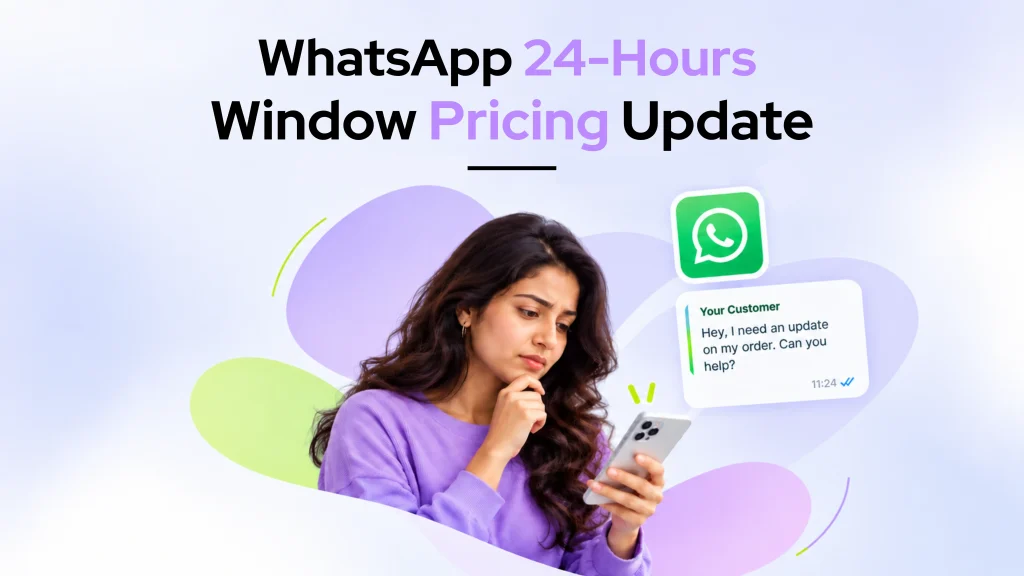
For years, businesses have treated WhatsApp‘s 24-hour customer service window as a reliable part of customer support. Once a customer sent a message, businesses could reply freely within the next 24 hours without worrying about delivery charges for those service messages. That will change on 1 October 2026 as part of Meta’s latest WhatsApp pricing update.
The 24-hour window is not going away. Customers can still message businesses, and conversations will still remain open for 24 hours. What changes is how businesses are charged. From 1 October 2026, service messages sent within that window will be chargeable, introducing a new cost that many support teams have never had to account for.
For businesses that rely on WhatsApp for customer support, order updates, and chatbot interactions, this is less about rewriting strategy and more about preparing operations before the pricing change takes effect.
What is WhatsApp’s 24-Hour Window?
The WhatsApp 24-hour window starts whenever a customer sends a message to a business. During those next 24 hours, the business can continue responding naturally without needing a message template for ordinary customer service conversations. Think of a customer asking, “Where is my order?” The business can reply with shipping updates, answer follow-up questions, clarify delivery timing, and continue helping until the conversation window expires.
This customer-led conversation model has made WhatsApp feel closer to live chat than traditional messaging. It has also encouraged businesses to resolve issues quickly while customers are actively engaged. That experience stays the same after October. The pricing doesn’t.
What Changes On 1 October 2026?
Meta is introducing charges for service messages sent during the 24-hour customer service window as part of its WhatsApp Business Platform pricing changes. Previously, these non-template service replies inside the window did not incur delivery charges. From 1 October, businesses will pay for those service messages, while other message categories continue to follow their existing pricing rules.
Here’s the difference.
- Service messages (inside the 24-hour window): Customer support replies sent after a customer messages your business. These become chargeable from 1 October 2026.
- Utility templates: Order updates, payment confirmations, and shipping notifications continue under template pricing.
- Marketing templates: Promotions, offers, and campaigns continue under marketing pricing.
- Authentication templates: OTPs and verification messages continue under authentication pricing.
In simple terms, businesses should not think of this as a new messaging category. Instead, it is a new pricing rule for conversations they are already having every day, according to Meta’s updated pricing documentation. (Source: developers.facebook)
Understanding the Different Message Types
One reason this update creates confusion is that businesses often use multiple types of WhatsApp messages without thinking about their technical categories.
Service Messages
These WhatsApp non-template messages are sent during an active customer service conversation. For example:
- Answering product questions
- Troubleshooting an issue
- Helping with returns
- Responding to delivery questions
These are the messages affected by the October pricing update.
Utility Templates
Utility templates are pre-approved messages used for important customer updates. Examples include:
- Order confirmations
- Shipping notifications
- Appointment reminders
- Payment receipts
These continue to follow Meta’s existing template pricing model.
Meta Business Agent Messages
The pricing update also comes alongside a broader shift in how businesses handle customer conversations, with AI-powered agents becoming more common on WhatsApp. Meta is expanding Business Agent capabilities, allowing AI-powered agents to participate in customer conversations.
More than a million businesses are already using Meta Business Agent, indicating the growing adoption of AI-powered business-to-customer conversations on Meta’s platforms. (Source: Facebook.meta)
These agent interactions can still take place during customer conversations, but businesses will need to understand how different types of messages are charged as these experiences become more automated.
The bigger takeaway is that automation does not automatically mean lower costs. As more customer support moves to AI-powered conversations, businesses will need to look beyond simply automating replies and focus on making those conversations efficient and purposeful.
Why This Matters for Businesses
For many companies, the impact of these WhatsApp pricing changes in 2026 may become more noticeable as conversation volumes increase. The scale of business messaging makes this shift worth paying attention to. Meta said paid WhatsApp messaging crossed a $2 billion annual run rate in Q4 2025, underscoring the scale of WhatsApp’s business messaging ecosystem. (Source: about.meta) A support team handling thousands of WhatsApp conversations every day may suddenly find that routine replies now contribute to messaging costs.
As messaging costs become more visible, measuring conversation quality becomes just as important as measuring conversation volume.
Support Workflows May Need Redesigning
Many chatbot flows still send multiple short replies. Instead of sending:
- “Hi!”
- “Checking that for you.”
- “One moment.”
Businesses may want to consolidate those into fewer, more meaningful responses. Fewer messages can create a smoother customer experience while also reducing unnecessary delivery costs.
Human Agents Need Clearer Conversation Paths
Support teams may also benefit from making conversations more efficient. Long back-and-forth exchanges that add little value become more expensive after October. This is not about rushing customers. It is about making every message more useful.
Automation Becomes More Strategic
Businesses using platforms like TrustSignal can assess their chatbot journeys, support flows, and conversation triggers before the WhatsApp pricing change arrives, helping ensure conversations stay efficient without sacrificing customer experience. Preparing early can reduce the need for last-minute operational changes later.
The 72-Hour Exception Businesses Should Know
Not every customer conversation follows the same rule. When a customer starts a conversation by clicking a Click-to-WhatsApp or Click-to-Facebook advertisement or call-to-action button, businesses receive a 72-hour free entry point window.
During this period:
- Customers can continue the conversation.
- Businesses can respond.
This exception is particularly important for brands using Click-to-WhatsApp ads, as the 72-hour window continues to provide free message delivery under Meta’s entry point rules. For brands already investing in WhatsApp ads, understanding this distinction becomes increasingly important as support pricing evolves.
One Deadline Businesses Should Not Miss
There is also an important billing step businesses should complete before the pricing update takes effect. Before 30 September 2026, businesses should add a valid payment method to their WhatsApp Business Platform account. Without a payment method, businesses may face disruption once service message charges begin on 1 October 2026. For teams managing multiple WhatsApp numbers or business accounts, this is worth verifying now rather than waiting until the transition period.
The Bigger Takeaway
Meta’s latest WhatsApp pricing update reflects a broader shift in business messaging. As customer conversations become more valuable, businesses are being encouraged to use them more intentionally. Meta’s latest WhatsApp pricing update reflects a broader shift in business messaging. The 24-hour customer service window remains in place, but businesses now have a financial reason to make every support message count.
The weeks before 1 October 2026 offer a practical opportunity to audit chatbot flows, review agent workflows, eliminate unnecessary messages, and confirm billing readiness. Businesses that make those adjustments early can enter the new WhatsApp pricing model with a clearer view of their messaging costs and customer support workflows.