

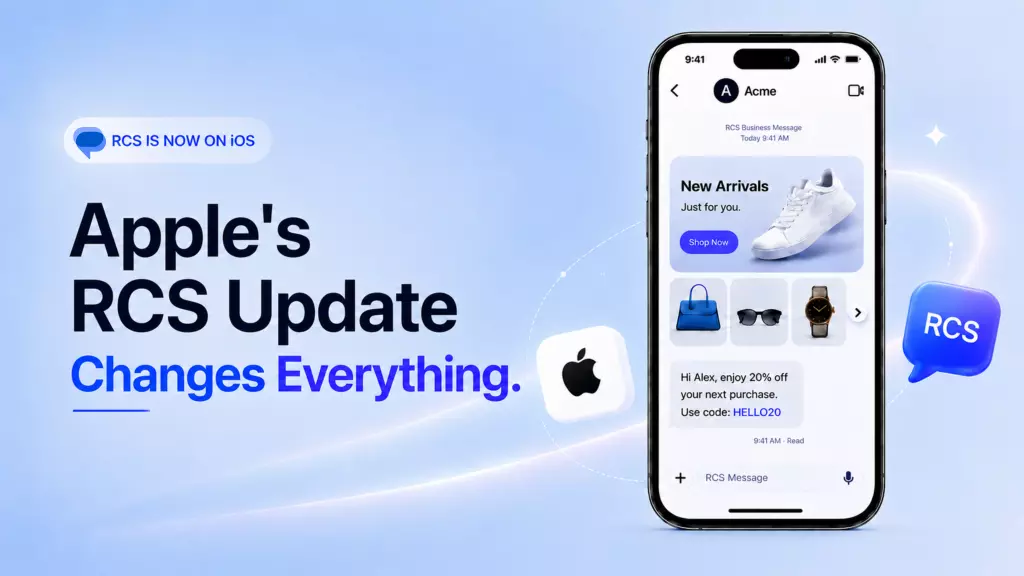
For nearly a decade, mobile messaging lived with a paradox.
Brands invested heavily in creating rich, app-like customer experiences inside messaging channels—interactive carousels, product catalogs, verified sender identities, one-tap actions, and conversational journeys. Yet the experience remained fundamentally fragmented. Whether a customer received that experience depended not on the brand’s strategy, but on the smartphone in their pocket.
Android users could engage with the full potential of Rich Communication Services (RCS). iPhone users largely could not.
As a result, marketers were building a channel that could reach only a fraction of their audience. In the United States, despite growing enthusiasm around RCS, brands could realistically access only about 40% of consumers through the channel because Apple’s ecosystem remained outside the RCS universe. The challenge was never consumer demand—it was ecosystem fragmentation. (Source: MarTech)
India presented a different market dynamic but arrived at the same limitation. With Android accounting for over 93.22% of the mobile operating system market, RCS adoption was already accelerating. Yet even here, the channel’s growth was constrained by the absence of a truly universal messaging experience. No matter the market, RCS remained a powerful but incomplete opportunity. (Source: Stat Counter)
That changed with iOS 18.
Apple’s decision to support RCS was more than a protocol update. It marked the moment mobile messaging evolved from a platform-specific capability into a genuinely mainstream customer engagement channel.
For the first time, brands could design rich messaging experiences without thinking about operating system boundaries. What had long been a fragmented ecosystem suddenly became a unified one, bringing nearly 900 million active iPhones into the RCS landscape and fundamentally expanding the reach of business messaging. (Source: Mordor Intelligence)
The significance of this shift extends beyond compatibility. It represents a broader change in customer expectations.
The Shift Nobody Can Afford to Ignore
The scale of that shift became apparent almost immediately. Google reported that over one billion RCS messages are now sent daily in the U.S. alone, a figure driven in large part by Apple’s inclusion in the ecosystem, and global RCS business messaging adoption has grown approximately 30x over the past two years. (Source: 1440) According to Juniper Research’s April 2026 report, RCS business traffic reached 70 billion messages globally in 2025 and is on course to exceed 200 billion by 2027. (Source: Juniper Research) That is not a niche channel finding its footing; that is a mainstream communications infrastructure that brands simply cannot build around.
Why RCS Performs the Way It Does
The performance gap between RCS and traditional messaging channels is not marginal. It is structural.
SMS delivers a text string. Email delivers a message into a crowded inbox that most recipients have trained themselves to ignore or defer. RCS delivers something fundamentally different, a branded, verified, visually rich interaction that arrives in the same place as a personal message, without asking the customer to download an app, click through to a browser, or navigate away from what they were doing. The channel collapses the distance between a brand’s message and the customer’s action.
That distinction matters because friction is where conversions die. Every additional step between receiving a message and completing an action is an opportunity to lose the customer. RCS removes several of those steps by design; product carousels, one-tap CTAs, verified sender identity, and real-time read receipts are all native to the messaging thread. The customer does not need to trust the message enough to click on an unknown link. They can see exactly who sent it and act directly within it.
The result is a channel that earns attention rather than demanding it. Where SMS interrupts and email competes for eyeballs in a cluttered inbox, RCS arrives as something worth engaging with. For brands, the strategic implication is straightforward: the closer a message gets to replicating an in-app or in-store experience, the less work a customer has to do to convert. RCS is currently the only native messaging format capable of delivering that experience at scale
What Brands Need to Do Now
The expansion of RCS across both major mobile ecosystems fundamentally changes the size of the addressable audience. The opportunity is now significantly larger, but success will depend on more than simply enabling the channel. Brands need to rethink how they establish trust, design customer experiences, and measure performance within an increasingly intelligent messaging ecosystem.
1. Get Verified Before You Communicate
RCS is built around trust. Unlike SMS, businesses cannot send branded RCS messages from an unverified identity. Before launching a campaign, brands must complete sender verification, creating an RCS business profile with a registered name, logo, and verification badge. The badge is more than a visual element; it is the customer’s first indication that the message is authentic.
As of June 2026, verified sender profiles appear across both iOS and Android in the U.S., allowing brands to present a consistent identity across the two largest mobile ecosystems.
2. Design for Rich, Interactive Experiences
One of RCS’s biggest advantages is its ability to move beyond plain text. Images, videos, carousels, and interactive CTAs allow brands to create experiences that are closer to a storefront than a text message. The strongest campaigns use this space intentionally, leading with compelling visuals and limiting carousel layouts to three to five cards to keep interactions focused.
On iOS, however, rich card text is limited to approximately 144 characters per card. Rather than treating this as a technical limitation, brands should view it as a design constraint that encourages clearer, more concise messaging.
3. Make Personalisation Meaningful
Adding a customer’s first name is no longer enough. The most effective RCS campaigns use behavioural and transactional data to personalise the content itself, from recently viewed products and abandoned carts to loyalty status and location. When recommendations reflect genuine customer intent, engagement naturally improves. In 2026, this level of relevance is becoming the expectation rather than the exception.
4. Build Every Campaign With Fallback in Mind
Although Apple’s support has significantly expanded RCS adoption, Business Messaging is not yet universally available across every market, carrier, and device combination. When RCS is unavailable, messages automatically fall back to SMS.
That makes fallback planning a strategic requirement rather than an afterthought. Every campaign should communicate its core message effectively, even without rich media, ensuring customers receive a coherent experience regardless of how the message is delivered.
5. Measure Engagement, Not Just Delivery
RCS provides a level of interaction data that SMS simply cannot match, including read receipts, button taps, carousel interactions, and customer-level engagement signals. The value lies not in collecting more metrics, but in using them to continuously improve campaign performance.
Brands that refine send times, optimise message sequences, and test different interactive formats will build a growing performance advantage over time. The analytics already exist. The competitive advantage comes from acting on them.
The Trust Layer Brands Cannot Ignore
As messaging channels become more sophisticated, trust is becoming just as important as reach and engagement. Customers are increasingly cautious about the messages they receive, particularly as phishing attempts, spoofed identities, and digital fraud continue to rise.
Features such as verified sender profiles, brand badges, and registered business identities help address this challenge by giving customers greater confidence that a message is genuinely coming from the brand it claims to represent. In an environment where credibility can influence whether a message is opened, ignored, or acted upon, trust is no longer a secondary consideration. It is becoming a fundamental part of the customer experience.
For brands, verification is not simply a technical requirement or compliance step. It is a visible signal of authenticity. As consumers place greater value on security and transparency, brands that invest in building trust in their communications will be better positioned to earn attention, engagement, and long-term loyalty.
Conclusion
The arrival of RCS across the iPhone ecosystem did more than expand the reach of business messaging. It transformed RCS from a promising channel into one that brands can now use at a meaningful scale. But scale alone is not the opportunity. The real opportunity lies in how brands use it to deliver richer experiences, build trust through verified identities, and remove friction from the customer journey.
As customer expectations continue to evolve, the brands that stand out will not simply be those that adopt RCS first, but those that use it with purpose. The technology is ready. The audience is ready. What remains is for brands to rethink what effective mobile messaging now looks like.