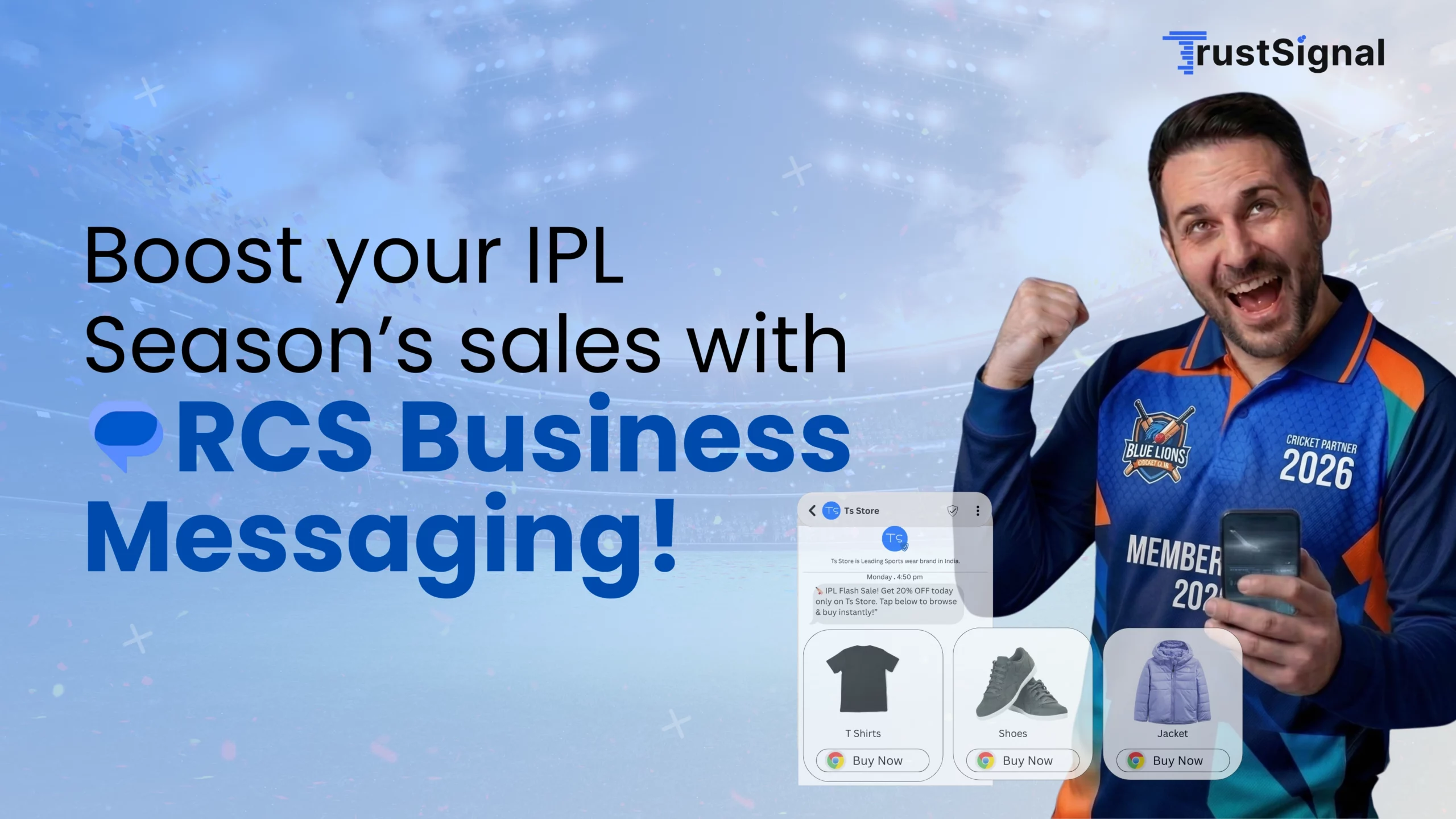
The Indian Premier League (IPL) was once about sixes, boundaries, and the colors of your favourite team. Today, it has become something much bigger; a moment where attention concentrates like nowhere else. For brands, IPL is the year’s most intense window to capture attention, influence behaviour, and drive real decisions. But the smartest brands understand one thing: attention doesn’t live on television anymore. It lives in conversations. During peak moments like IPL, over 90% of fans are glued to their phones. Matches are watched with a second screen in hand; scrolling, chatting, reacting, and sharing in real time.
The game isn’t just happening on the field; it’s happening across messaging apps, notifications, and digital conversations. That shift is exactly why brands are moving closer to where customers already are: their favourite communication channels. And the scale of this shift is massive. The global CPaaS market powering these conversations reached $25.2 billion in 2024 and is projected to surge to $98.7 billion by 2034. (Source: Global Growth Insights, Market Reports) Because in moments like IPL, winning attention isn’t about louder advertising. It’s about showing up in the conversation.
Concurrently, IPL fans now spend 5.7x more time engaging digitally, 400K+ app downloads, and 50 to 65% response rates on mobile campaigns during matches. This second-screen explosion turns IPL into a live lab for communication channels. (Source: Indian Television, IPL Fan Engagement) Most brands approach the IPL season with, “Which channel should we use?” That’s the mistake. Brands must choose their channels with a role-assigning approach. Beneath all the noise, there is a hierarchy that decides whether your campaign converts or just gets seen. Here, TrustSignal will unpack this through IPL-driven behaviour.
IPL Is a Multi‑Stage Communication Playbook
During the 2025 IPL, brands witnessed 15–25% higher engagement from dual-screen campaigns, with 3x conversions when second-screen triggers synced with match moments. Fans aren’t just watching, they’re tapping, chatting, predicting, reacting across screens simultaneously. This makes IPL not just “one campaign moment” but a three-stage communication window: (Source: Exchange4Media, Multi-Screen Viewing)
- Pre-match: Curiosity, intent-building, prediction behaviour
- Live match: Impulse, emotion, real-time reaction
- Post-match: Reflection, reward, retention
Within each stage, every channel has a fit zone and a fail zone, a hierarchy that goes beyond “popularity” and into strategic discipline.
1. WhatsApp: The Engagement‑First Channel
As marketing‑media coverage of IPL‑driven communication highlights, brands are increasingly using click‑to‑message‑style campaigns on WhatsApp during IPL, where fans click an ad and land directly in a conversational inbox. Reports on these campaigns indicate that Click‑to‑Message on WhatsApp generated a 30% uptick in customer engagement and 45–60% conversion rates, far above traditional display or email. (Source: Pitchonnet)
In IPL 2025, brands spent roughly ₹7,000 crore, which is expected to grow to 10–15% in the IPL 2026 season, and the league pulled 652 million viewers and 840 billion minutes of watch‑time, with 40% YoY digital growth and a 54% surge in Connected TV. Top performers like Dream11, Swiggy, and Zomato saw 37.7% brand recall, 4× higher CTRs, and 300,000+ app downloads, while video‑ad engagement spiked 21× during matches. (Source: LinkedIn, Sports Marketing)
WhatsApp sits at the heart of this performance stack as the engagement‑first channel:
- For live‑match polls and prediction games.
- For personalised flash offers triggered by key moments.
- For short, conversational journeys (“Click, pick, redeem”) that convert high‑CTR, high‑excitement windows into measurable outcomes.
However, WhatsApp relies on opt‑in consent, so you can’t blast like SMS, and if overused, it triggers notification fatigue.
Hierarchy rule: WhatsApp should lead moments of interaction, not carry the weight of mass communication.
2. RCS: The Rich‑Broadcast Challenger
Business‑and‑media‑style coverage of IPL‑driven digital‑ad‑growth notes that IPL‑specific advertising has grown from ₹102 million in 2008 to ₹620 million in 2024, with projections for ₹700–800 million in 2025, and stronger regional‑language‑driven reach. This environment has pushed brands to experiment with geo‑targeted, cricket‑themed, and context‑aware offers during match breaks, often via rich, app‑like experiences. (Source: Marketing Mind)
Industry‑trends reporting on rich‑messaging formats suggests that RCS‑style rich‑broadcast layers now drive 2–3× higher engagement and click‑throughs than traditional SMS, with many campaigns seeing 60–70% higher conversion rates compared to MMS-style messages. (Source: Marketing Mind)
RCS sits between:
- Passive consumption (SMS)
- Active engagement (WhatsApp)
It’s where curiosity turns into intent.
Use it for:
- Visual offers
- Mini-storefronts
- Quick, interactive previews
But here’s the catch:
- RCS doesn’t win on the ground. It wins on experience quality before the click.
- Brands that expect RCS to perform like WhatsApp will be disappointed.
- Brands that use it to prepare users for WhatsApp will see a lift across both.
Hierarchy rule: RCS is not the hero; it’s the bridge that makes other channels perform better.
3. SMS: The Silent Workhorse We Are Forgetting
Coverage of Indian cricket‑fan behaviour highlights a highly mobile‑first audience that is already conditioned to respond to SMS for OTPs, recharges, and last‑minute alerts. It is also further shown that SMS‑driven flash‑sale offers often see 15–25% higher open‑rates than email‑based promos, while SMS‑driven transactional‑triggers maintain 70–80% open‑rates but 30–40% lower engagement depth than rich‑channel experiences. (Source: The Economic Times)
SMS remains the most reliable way to:
- Deliver time-sensitive nudges
- Trigger last-mile actions
- reach users regardless of app behaviour
But here’s the uncomfortable truth: high open rates do not equal high impact. SMS gets seen. It doesn’t always get acted on. Which is why using SMS for rich, interactive moments doesn’t just underperform, it wastes the moment entirely.
Hierarchy rule: SMS should close loops, not create experiences.
4. Push, In‑App, and Email: The Supporting Cast
Reports show that 80% of IPL fans use second screens during live matches, with Dream11 projecting 5 Cr users across creator-driven engagement platforms. This proves how deeply embedded app-based interactions have become. Real-time marketing playbooks show brands using geo-targeted, innings-break-triggered offers to drive immediate action. (Source: Inc42.com, Second Screen Economy)
Within this ecosystem:
- Push and in‑app fit best for logged-in, app‑native users, for example, “Add cash before the big match” or “Your fantasy‑team‑related offer is live.”
- Email fits best for pre‑match narratives, team‑wise previews, and slower‑burn loyalty campaigns, not for real‑time spikes.
These channels rarely “win” the IPL conversation, but they reinforce it. Used thoughtfully, they keep your brand top‑of‑mind between-match moments while your real‑time layers (WhatsApp, RCS, SMS) drive spikes.
Mapping Campaign Types to the Hierarchy
Most IPL playbooks focus on tactics, gamification, flash sales, and influencer drops. What they miss is ownership. Because campaigns don’t fail due to weak ideas. They fail when the wrong channel leads the moment.
1. Gamification, predictions, contests
These are interaction-led moments. They rely on users tapping, choosing, and reacting in real time. WhatsApp works best as the lead layer, with RCS supporting through richer, visual experiences. Together, they turn curiosity into action. Where brands go wrong is trying to drive this through SMS.
2. Flash sales and time-sensitive offers
These are urgency-led moments, where speed matters more than experience. SMS should lead here, simply because it guarantees reach. WhatsApp then works as a secondary layer, adding depth once the user clicks through.
3. Loyalty, retention, cross-sells
These are not real-time IPL moments. They are continuity moments. Push and in-app should lead for users already in your ecosystem, while WhatsApp and email support with more personalised or narrative-led communication. The mistake here is subtle, treating retention like a campaign spike instead of a system. And that’s where long-term value gets diluted. The shift is simple, but often missed.
Instead of asking which channel to use, start asking: Which channel should lead, and which should support?
Because over time, a clear pattern emerges:
- Interaction needs conversational channels
- Urgency needs a reliable reach
- Retention needs continuity
One rule is worth remembering: Defaulting to SMS for interactive moments doesn’t simplify the campaign; it weakens it.
Conclusion
IPL-focused strategy guides correctly highlight the rise of moment-based, gamified, and geo-targeted campaigns across pre-match curiosity to post-match retention. What they miss is the layer that actually determines performance, the channel hierarchy behind those moments. The job isn’t to pick a “hero channel.” It’s to assign roles with precision. WhatsApp drives interaction. SMS guarantees reach. RCS enhances experience. Push and email sustain the relationship beyond the match.
Every channel has a place. But when roles are misassigned, even strong campaigns underperform. During IPL, success doesn’t come from being present across channels. It comes from knowing which channel should lead, and which should stay in the background.