

Rich Communication Services (RCS) has evolved far beyond basic business messaging, and with the arrival of RCS 4.0, the channel is becoming more interactive, intelligent, and brand-ready than before. As the modern messaging protocol for Android, RCS replaces plain SMS with native, app-like features such as rich media, read receipts, and branded sender identity. The latest iteration builds on those capabilities with richer media support, stronger verification, and improved analytics, turning messaging into a more performance-driven customer engagement layer.
Globally, the RCS ecosystem has grown from around USD 10.09 billion in 2025 to an estimated USD 13.65 billion in 2026, with the market projected to reach USD 46.75 billion by 2030 at a 36% compound annual growth rate, clearly positioning RCS as a core pillar of digital conversation, not just a supplementary channel. (Source: Research and Markets)
In India, the momentum is equally striking: more than 600 million Android devices are already RCS‑capable, and campaigns across BFSI, retail, and e‑commerce typically see 3–7× higher click‑through rates versus traditional SMS, with read rates above 70–80% and button‑interaction rates in the 15–25% range. As customer expectations continue to shift toward faster, more personalised, and seamless digital interactions, brands are under increasing pressure to make communication more interactive and context‑aware. (Source: MDS Blog)
In this environment, RCS 4.0 arrives not just as a technical upgrade, but as a strategic lever: it lets brands move beyond one‑way alerts and turn routine notifications into interactive, in‑pocket experiences that can capture intent, complete tasks, and deepen trust, all within the native messaging canvas.
What’s new in RCS 4.0
RCS 4.0 doesn’t reinvent messaging; it removes key limitations that held RCS back for advanced customer‑experience scenarios. The Universal Profile 4.0 refines the core P2P layer so brands can deliver richer, more context‑aware conversations, not just visually upgraded notifications. (Source: GSMA – RCS Universal Profile 4.0)
1. Rich text formatting in business messages
Until 4.0, RCS business messages were richer than SMS but limited in text emphasis. Now brands can use bold for key information, italics for tone or context, and strikethrough for corrections or updates. This improves clarity for offers, instructions, and time‑sensitive actions, helping users scan and respond faster.
2. Higher‑quality media with device‑aware delivery
RCS 4.0 introduces media format negotiation, so images, videos, and audio are automatically optimized for the receiving device and network. This results in sharper visuals, fewer failed or degraded media deliveries, and a more consistent experience across Android and emerging iOS‑RCScapable environments, especially valuable for product discovery and visual support.
3. Backward compatibility and fallback
Despite the richer features, RCS 4.0 maintains reliability by gracefully falling back to plain text or SMS‑style delivery when rich features are unavailable. This ensures the message still lands, even if the full RCS experience is temporarily out of reach.
Why These Changes Matter for Brands
RCS 4.0 matters because customer communication is no longer judged only by speed; it is judged by experience. A report shows that 89% of consumers have signed up to receive business texts, signalling that messaging has become the primary channel through which they expect brands to engage with them. In the same survey, 67% of consumers say they are more likely to purchase from a business whose texts they subscribe to, proving that two‑way, permission‑based messaging directly boosts trust and conversion. (Source: PR Newswire)
With richer visuals, verified sender identities, and in‑thread actions, RCS turns routine notifications into part of the customer journey, not just interruptions. The report also finds that 64% of consumers are more likely to click or purchase when a promotional text includes an image, reinforcing that interactive, context‑aware messaging formats outperform plain‑text SMS. Meanwhile, 46% of consumers now prefer texting over phone calls to contact a business, and they expect to resolve queries, update details, and complete tasks directly within the message thread. (Source: PR Newswire)
For brands, this means RCS 4.0 is not just a visually richer channel; it is a strategic layer where clearer value, verifiable identity, and richer, image‑backed conversations build trust, increase engagement, and turn everyday notifications into dynamic, conversation‑led experiences.
How Businesses Can Use RCS 4.0
RCS 4.0 (RCS Universal Profile 4.0) lets businesses turn the default phone messaging app into an interactive, app‑like channel for customer engagement, support, and commerce. For marketers and product teams, this means higher engagement, richer‑media conversations without forcing users into a separate app.
Core ways businesses can use RCS 4.0
1. Rich, interactive marketing and sales
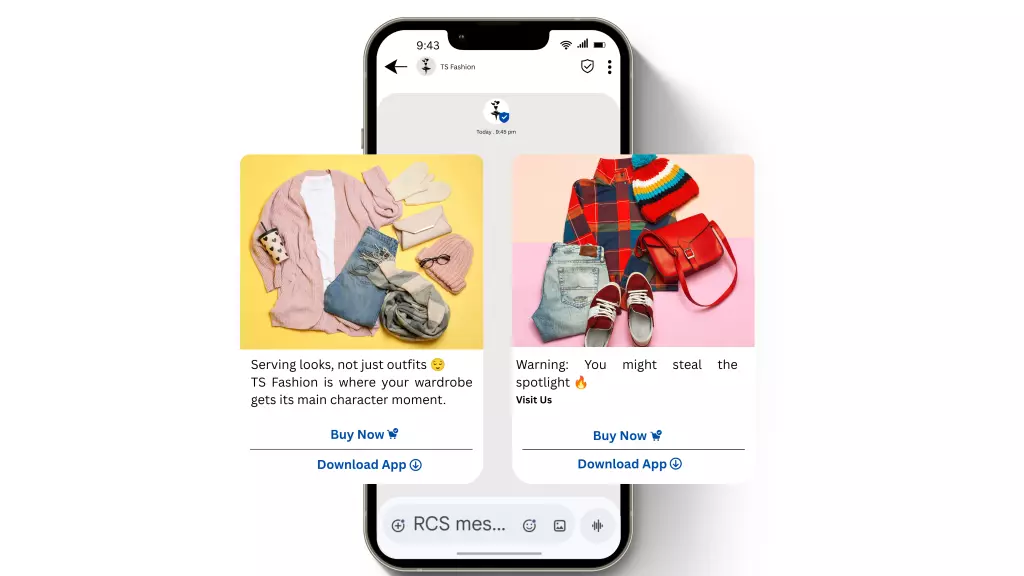
Send product carousels with high‑resolution images, videos, pricing, and “tap‑to‑buy” or “book now” buttons directly in the chat. Run time‑bound offers with countdown timers, embedded video ads, and on‑click redemptions, boosting conversion vs plain SMS.
2. Customer service and self‑serve support
Use rich cards and suggested replies to guide users through FAQs, troubleshooting steps, or appointment booking without leaving the message thread. Embed short instructional videos or GIFs in support messages (e.g., “how to top‑up your balance” or “track your ticket”) instead of linking out to a web page.
3. Omnichannel journeys and commerce
Trigger order confirmations, delivery tracking, and post‑purchase surveys with interactive cards; users can view live tracking, reschedule a delivery, or rate the service in‑thread. Integrate with CRM, ecommerce, and payment systems so RCS becomes a mini‑checkout or booking flow, including in‑message payments where supported.
4. Onboarding and retention
Send welcome journeys with interactive tutorials, branded videos, and quick‑action buttons to guide new users (banks, fintech, telcos, SaaS). Reactivate dormant customers with visually rich, personalized nudges (loyalty updates, gamified scratch cards, or “special‑offer” videos) inside the default messaging app.
5. P2A (Person-to-Application) Messaging
P2A messaging lets customers initiate conversations with your brand directly from the default messaging app. Instead of waiting for you to send an alert, the user types “Hi” or taps a “Chat with us” button, and your RCS chatbot or agent responds with rich cards, quick replies, and in-thread actions. (Source: Google Developers)
RCS 4.0 vs Traditional Messaging
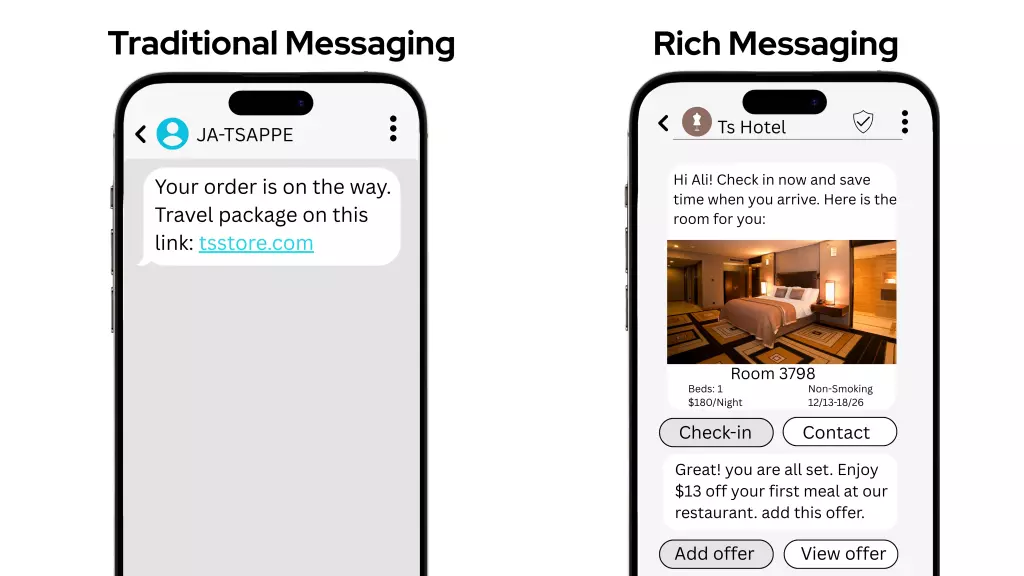
SMS is simple and functional: it delivers short text alerts, reminders, and basic notifications, but offers no rich media or interactivity. Older mobile messaging formats (like early MMS or basic mobile push) add images or slightly longer content, yet still feel static and limited in design and actions.
RCS 4.0 is richer and more interactive: it supports high‑quality images, videos, carousels, buttons, suggested replies, and even in‑thread video calls. Brands can display product catalogs, send short explainer videos, and guide users through purchases or support flows, all inside the same conversation thread, without forcing them into a separate app.
In short, while SMS and older formats mainly inform, RCS 4.0 lets brands engage, guide, and convert customers directly inside the messaging app.
What Marketers Should Think About Next
Marketers should start rethinking messaging as an experience, not just a notification channel. Instead of treating SMS or chat as a one‑way blast of text, they should design conversations that feel helpful, guided, and easy to complete, like a mini‑app inside the message thread.
The focus should shift from “how many people we reached” to “how useful and interactive the message was.” That means using rich visuals, quick‑tap buttons, and in‑thread flows (like booking, support, or checkout) so users can act without leaving the app.
Finally, marketers should build messaging journeys that are more visual, more responsive, and more measurable.
That includes designing end‑to‑end paths, welcome, onboarding, nurture, and re‑engagement, and tracking engagement, completion rates, and conversions at each step, so they can continuously refine messages based on real behavior, not just open rates.
Conclusion
RCS 4.0 is not just a technical upgrade to messaging; it’s a shift in how brands can communicate. It turns the default messaging app into a branded, interactive space where customers can discover, decide, and act without ever leaving the conversation.
As business messaging evolves, it is becoming more conversational, more visually branded, and more action‑led. The future belongs to brands that treat every message as a micro‑experience, not just a notification.