
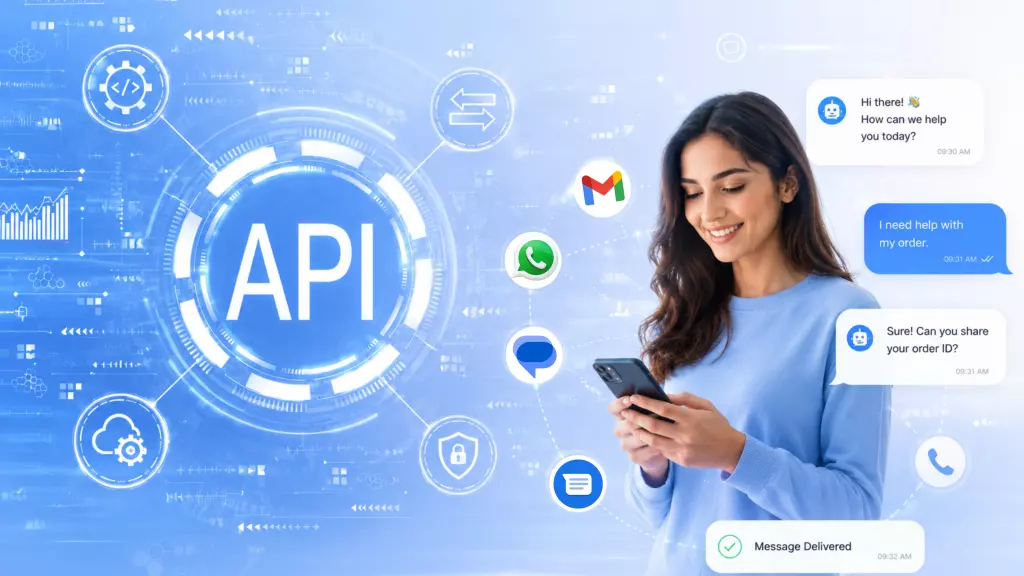
In 2026, a quiet but unmistakable tectonic shift is redefining how brands “talk” to their customers. The era of sporadic, one‑sided broadcasts, generic emails, and mass SMS blasts is giving way to a highly orchestrated, API‑first ecosystem where every interaction feels less like a campaign and more like a real‑time conversation. Underpinning this shift is a clear pattern: API‑first architectures are no longer just a technical idea; they have become the backbone of modern customer engagement, enabling brands to deliver personalised, context‑aware dialogue across channels at scale.
Globally, 82% of organizations now operate with an API‑first approach, and 25% describe themselves as fully API‑first enterprises, embedding externalized interfaces into their core product and experience strategies. (Source: SQ Magazine) At the same time, independent omnichannel research shows that companies with strong omnichannel engagement strategies retain around 89% of their customers, compared with roughly 33% for those that manage channels in isolation. (Source: Capital One Shopping)
As AI‑driven personalisation and proactive engagement become mainstream, businesses that fail to orchestrate these interactions through clean, standardized APIs risk being left behind in a world where every brand is judged on the quality, continuity, and trust of its conversation.
Customers Expect Dialogue, Not Broadcasts
Global messaging data paints a clear picture: consumer behavior has shifted from occasional inbox checking to an always-on messaging mindset. A 2026 Messaging Trends Report, which analyzed 628 billion interactions in 2025, found that 98% of customer interactions now span multiple channels, while single-channel journeys have dropped from 73% a decade ago to just 2.3%. At the same time, AI-driven conversational platforms such as WhatsApp and RCS are now powering the majority of two-way customer interactions. This transformation is not simply about channel expansion; it reflects a deeper change in how consumers expect to interact with brands. (Source: Business Wire)
Modern customer journeys rarely happen on a single platform anymore. A shopper may discover a product through social media, receive a promotional offer on WhatsApp, track an order through SMS, and resolve support queries through an AI chatbot, all within the same engagement cycle. What matters today is not just being present across channels, but maintaining continuity between them.
Customers increasingly expect brands to recognize previous interactions, respond instantly, personalise conversations based on context, and continue communication seamlessly across platforms. This is why conversational channels such as WhatsApp, RCS, SMS, and AI chat interfaces are becoming central to customer engagement strategies. Businesses are no longer competing solely on product quality or pricing; they are competing on responsiveness, convenience, personalization, and trust.
Consumer expectations around communication quality have also intensified. A 2026 consumer texting-behavior report based on 959 U.S. respondents revealed that 89% of consumers expect every message to “earn its place,” while nearly two-thirds say they are more likely to purchase from businesses they actively text with. SMS continues to remain essential for reliability and immediacy, but the real differentiator for brands today is context, the ability to deliver the right message, in the right channel, at the right moment, with the right intent. (Source: The AI Journal)
As a result, generic campaigns and repetitive promotions are rapidly losing effectiveness. Consumers now have far less tolerance for irrelevant communication, and poorly timed messaging can quickly erode engagement. In many industries, the quality of the communication experience itself has become a direct driver of purchase decisions, customer retention, and long-term brand loyalty.
APIs Have Become the Foundation of Modern Communication
The rise of API-first architecture has enabled brands to move beyond siloed communication systems and build connected customer journeys instead.
In practical terms, APIs allow communication to become integrated into every business workflow. A customer action can instantly trigger the next relevant interaction without manual intervention.
For example:
- A CRM update can automatically initiate a personalized WhatsApp follow-up.
- Payment failures can trigger real-time reminders through SMS or RCS.
- Delivery platforms can send live shipment updates across preferred channels.
- AI-powered support systems can escalate conversations to human agents while preserving context.
Instead of treating communication as a separate marketing activity, businesses are embedding it directly into operational systems.
This approach creates three major advantages:
1. Real-Time Responsiveness
Brands can react immediately to customer behavior, creating faster and more relevant experiences.
2. Scalable Personalization
APIs make it possible to tailor interactions at scale using customer data, behavior patterns, and AI-driven insights.
3. Unified Customer Experiences
Communication becomes consistent across departments, platforms, and customer touchpoints. In this environment, APIs function less like backend infrastructure and more like the operating system for customer engagement.
The Rise of AI Is Accelerating Conversational Commerce
Artificial intelligence is amplifying the value of API-driven communication ecosystems.
AI agents and conversational platforms are increasingly handling:
- onboarding flows,
- customer support,
- appointment scheduling,
- payment reminders,
- lead qualification,
- and post-purchase engagement.
However, AI alone is not the differentiator. The real value comes from how intelligently these systems connect with communication channels and customer data through APIs.
When integrated correctly, AI can:
- understand customer intent,
- retrieve contextual information instantly,
- automate repetitive interactions,
- and hand over complex conversations to human agents without disrupting the experience.
Customers expect efficiency from AI, but they also expect empathy and continuity when escalation is required. Poor transitions between automation and human support remain one of the biggest causes of customer frustration today.
This is why businesses are investing in unified communication layers that connect AI, messaging platforms, CRM systems, and support operations into a single ecosystem.
The Biggest Challenges Businesses Still Face
Despite the momentum behind API-first communication, many organizations still struggle with implementation.
1. Fragmented Systems
Legacy infrastructure often stores customer information across disconnected platforms, making it difficult to create synchronized experiences.
2. API Sprawl
As businesses rapidly adopt new tools and integrations, they frequently end up with duplicated APIs, inconsistent standards, and governance issues that increase operational complexity.
3. Security and Compliance Risks
With customer conversations flowing across multiple platforms, privacy and data protection have become critical concerns. Regulations such as GDPR and India’s Digital Personal Data Protection Act are forcing enterprises to rethink how communication data is stored, processed, and audited.
4. Inconsistent Customer Experiences
Without centralized orchestration, conversations can become fragmented. Customers often need to repeat information across channels, leading to frustration and lower trust.
To address these issues, leading enterprises are focusing on:
- centralized API gateways,
- standardized integration frameworks,
- unified customer data layers,
- and governance models that prioritize both scalability and compliance.
The goal is no longer just connectivity; it is controlled, secure, and intelligent connectivity.
Seize the Conversation Edge: Your API‑First Roadmap
In 2026, the shift from one‑sided campaigns to continuous, API‑first conversations is no longer optional, but a core condition for customer trust and retention. Those who embed APIs as the backbone of their omnichannel experience spanning SMS, WhatsApp, RCS, and AI‑driven dialogues are the ones shaping the future of engagement.
Yet this shift demands discipline: governance against API sprawl, compliance with evolving privacy rules, and clear guardrails for AI‑driven conversations. The path forward is simple but deliberate: audit your channels, prioritize conversational hotspots, test omnichannel flows, and measure continuity and trust, not just volume, but quality and trust of every interaction.