
With more than 3.3 billion users worldwide and over 150 billion messages exchanged every day, WhatsApp has evolved far beyond a personal messaging app. It has become one of the world’s primary communication platforms, fundamentally changing how people expect to interact—not just with friends and family, but with the businesses they buy from. (Source: Resourcera)
Yet many businesses believe they’re using WhatsApp effectively simply because they’re present on the platform.
They’re sending promotional campaigns, sharing order updates, answering customer queries, and occasionally running automated workflows. On the surface, that sounds like a well-rounded messaging strategy.
But being active on WhatsApp isn’t the same as using it strategically.
In many organisations, every interaction exists in its own silo. Marketing uses WhatsApp to promote offers and drive sales. Operations rely on it for order confirmations, shipping updates, and payment notifications. Customer support steps in only when a customer initiates a conversation. Each interaction fulfils its purpose, but very few are connected in a way that creates a continuous customer experience.
This raises an important question: Is your business using WhatsApp to send messages, or is it using WhatsApp to build conversations?
As AI assistants become increasingly capable and customers grow more comfortable completing purchases, resolving issues, and discovering products through messaging apps, every conversation has the potential to become an end-to-end customer journey rather than a single interaction.
That distinction matters now more than ever. As customer expectations evolve, the value of WhatsApp no longer lies in how many messages a business sends or how quickly it responds. It lies in how seamlessly every interaction fits into a larger customer journey. A promotional campaign should recognise a recent purchase. A support conversation should have access to previous interactions. A delivery update should feel like a continuation of the same relationship, not the beginning of a new one.
The businesses creating the strongest customer experiences aren’t treating promotional messages, transactional updates, and support conversations as separate functions. They’re designing them as connected moments within a single, ongoing conversation.
The 24‑Hour Window: The Rule You’re Probably Under‑using
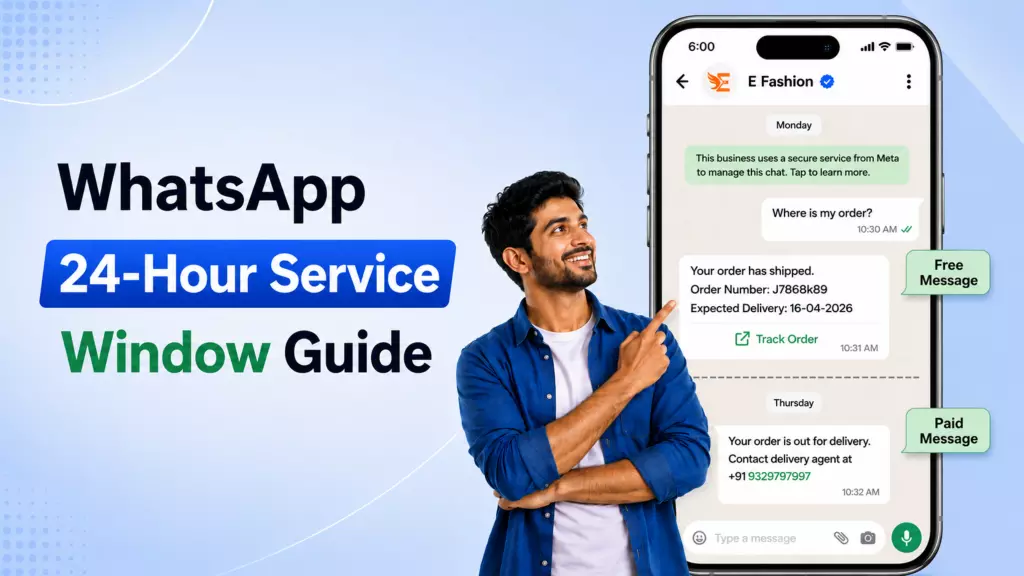
The WhatsApp 24‑hour window—officially known as the customer service window—is one of the most generous rules in modern business messaging. Yet, most organisations treat it as a technical constraint rather than a strategic asset. Whenever a customer sends a message to your WhatsApp Business number, it opens a 24‑hour session during which your brand can exchange free‑form messages without needing pre‑approved templates. After that window closes, communication shifts back to template‑based notifications that are more structured, more regulated, and often less conversational.
In practice, many teams do surprisingly little with those 24 hours. A customer asks a question, the business sends a single reply, and the conversation quietly stalls. There is no follow‑up to clarify the issue, no guided path to the right product or resolution, no proactive check‑in a few hours later to confirm that the customer achieved what they were trying to do. The window is technically open, but the relationship is not being actively developed.
Viewed through the lens of customer conversation ecosystems, the 24‑hour window should be one of the most valuable moments in the customer journey. Inside that period, brands can move beyond simple question‑and‑answer to orchestrated interactions: a support message that seamlessly hands off to a troubleshooting flow, a product inquiry that evolves into personalised recommendations, or a status update that invites the customer to choose how they want to be notified next—across WhatsApp, SMS, email, or app. Because every reply is still user‑initiated at this stage, the business has permission to deepen the conversation without resorting to broadcast tactics.
Under‑using the 24‑hour window is therefore not just a compliance issue; it is a missed opportunity to create continuity when the customer is most engaged. Brands that treat this rule as a dynamic conversation space—rather than a countdown clock—are able to turn routine WhatsApp interactions into connected experiences that carry over to other channels, reduce effort, and build the kind of relationship customers expect but rarely receive.
The Shift in Thinking: From Notifications to Invitations
Most brands still think of WhatsApp templates as messages to be delivered rather than conversations waiting to happen. The logic is simple—templates exist to push notifications outside the 24‑hour window, so teams use them to deliver information and then hope the customer pays attention. It is an understandable habit, but it quietly reinforces the very problem this blog began with: more messages, more channels, and yet very few genuine conversations.
WhatsApp’s design makes a different use of templates possible. The moment a customer replies to a template, a new 24-hour customer service window opens, restoring the ability to send free-form messages. In other words, templates are not just a way to talk at customers; they’re an opportunity to invite customers back into an active conversation. That shift requires businesses to rethink how they design outbound messaging. Rather than asking, “What information do we need to send?”, the better question is, “What would encourage the customer to respond?” A delivery confirmation might invite the customer to ask questions about their order.
A billing reminder could offer a choice of payment options through quick replies. A product announcement might connect the customer directly to personalised assistance instead of a static landing page. The objective is no longer just to deliver information but to create a low-effort path back into a conversation where context is preserved, and every interaction builds naturally on the last.
When organisations make this shift, the role of outbound messaging changes. Templates stop being the end of a communication campaign and become the beginning of a relationship moment. Instead of measuring success purely by delivery rate, they start asking how many invitations turned into active conversations—and how many of those conversations reduced effort, resolved issues faster, or opened the door to long‑term value.
The Cost Advantage Businesses Often Overlook
The highest-value customer conversations rarely begin with promotions. They begin with moments that are already relevant to the customer. Ironically, some of the most commercially valuable conversations begin with interactions that were never intended to sell anything at all. When a business sends an outbound marketing template to initiate or re-engage a conversation outside WhatsApp’s customer service window, that message is chargeable. For organisations communicating with thousands or even millions of customers, these costs can quickly add up.
However, once a customer replies and a 24-hour customer service window is opened, the economics of the conversation change. During this period, businesses can exchange free-form messages naturally with the customer. Utility messages, AI-powered conversations, and chatbot interactions can also continue within the ongoing dialogue without repeatedly relying on new outbound marketing templates to keep the interaction alive.
This creates an important shift in how businesses should think about outbound messaging. Rather than viewing a marketing template as the entire campaign, businesses can treat it as a conversation starter. Once the customer responds, AI agents and chatbots can answer questions, recommend products, guide purchases, resolve common issues, and personalise the experience within the same conversation. Rather than repeatedly paying to restart conversations, businesses can focus on extending conversations that customers have already chosen to join.
The objective is no longer to pay for every customer interaction. It’s to invest in opening meaningful conversations and maximise the value created while that conversation remains active.
Turn High-Intent Moments into Meaningful Conversations
One of the most overlooked opportunities in WhatsApp marketing isn’t sending more promotional messages—it’s making better use of the conversations that have already begun.
Utility messages, such as order confirmations, payment receipts, shipping updates, and appointment reminders, naturally capture a customer’s attention because they’re directly relevant to something the customer has just done. They also cost significantly less to send than outbound marketing templates, making them a natural and cost-efficient starting point for a broader customer conversation.
The real opportunity lies in what happens next.
Consider a customer who has just completed a purchase. Instead of ending the interaction with a simple confirmation, the business includes a quick reply asking about their shopping experience:
“Your order #45231 is confirmed! We’ll notify you as soon as it ships. Before you go, how was your shopping experience?”
Loved it | Could have been better
When the customer responds, the conversation becomes active within WhatsApp’s customer service window. From there, the business can continue the interaction naturally. An AI assistant or chatbot might answer follow-up questions, recommend complementary products based on the customer’s purchase, share loyalty programme information, or help complete a previously abandoned purchase—all within the context of an ongoing conversation. This is also the direction in which customer engagement platforms are evolving.
Rather than treating WhatsApp as a standalone messaging channel, platforms such as TrustSignal increasingly reflect this industry shift by bringing together AI, automation, and customer context into a single conversational journey.
The objective isn’t to replace marketing campaigns or avoid promotional messaging. It’s important to recognise that some of the highest-value customer interactions begin with moments that are already relevant and expected. Building on those moments often feels more natural than interrupting customers with an unsolicited promotion.
From a commercial perspective, this approach is also more efficient. Rather than repeatedly paying to re-initiate conversations with outbound marketing templates, businesses can maximise the value of interactions that customers have already chosen to engage with.
The key, however, is intent. Every follow-up should feel like a logical continuation of the customer’s journey, not a sales pitch disguised as customer service. When recommendations, offers, or support are genuinely relevant to the conversation, they enhance the customer experience rather than interrupt it.
The Bottom Line
Businesses often think of WhatsApp as another channel for sending messages. Increasingly, the most successful brands are treating it as a platform for building conversations.
That requires a shift in mindset. Instead of viewing each message as the end of an interaction, businesses should design every message as the beginning of one. An order confirmation can become a feedback opportunity. A customer query can evolve into a personalised recommendation. A promotional campaign can open the door to a richer, two-way conversation rather than a one-way broadcast.
The 24-hour customer service window is more than a pricing model. It encourages businesses to focus on sustained customer engagement instead of isolated campaigns. Those who make the most of it won’t necessarily be the ones sending more messages—they’ll be the ones creating conversations that feel timely, relevant, and genuinely helpful.
Ultimately, the value of WhatsApp doesn’t lie in how many messages a business sends. It lies in how effectively each interaction contributes to a continuous customer relationship. The businesses that succeed on What