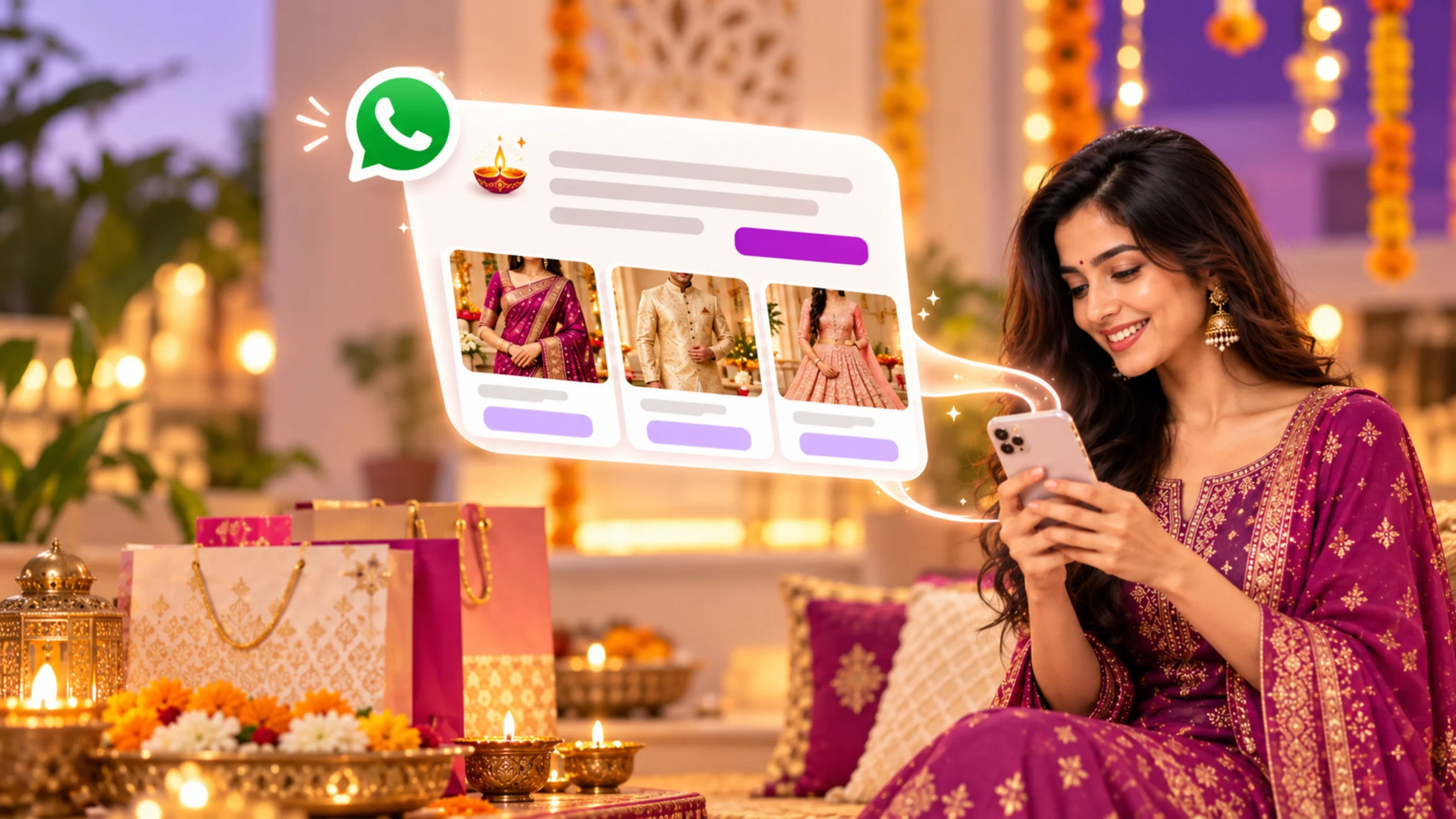

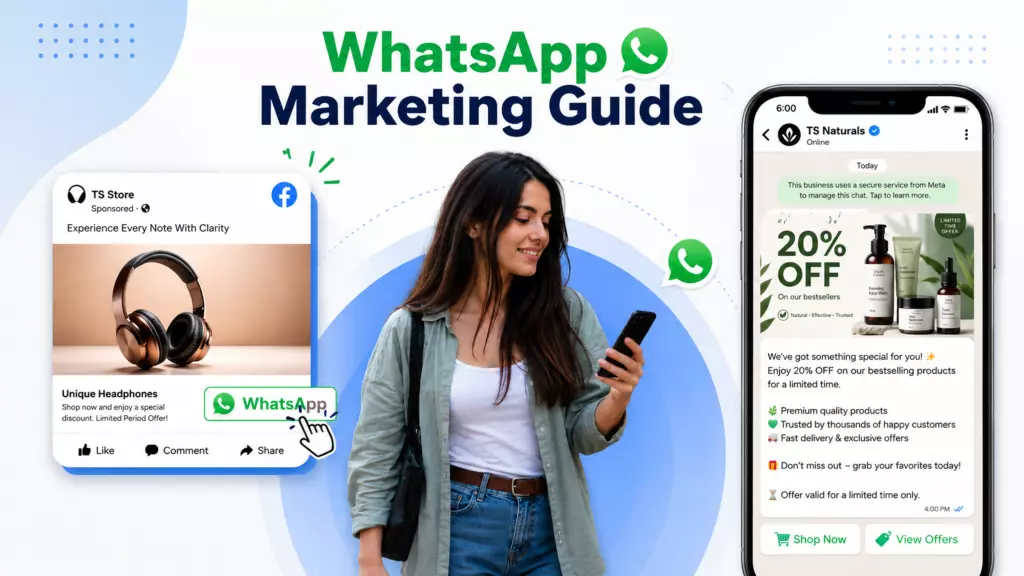
Customer communication has changed significantly over the past few years. Consumers no longer want to wait hours for email replies, navigate overloaded support portals, or interact with brands through one-sided advertising. They expect faster, more direct, and more personalised conversations — often on platforms they already use every day.
That shift is one of the biggest reasons why WhatsApp has become a major business communication channel globally. WhatsApp reached 3.14 billion monthly active users globally in Q1 2026, marking significant growth from 2.8 billion users recorded in 2024, according to Meta’s Q1 2026 investor briefing. It is now being used for customer support, lead nurturing, transactional updates, sales conversations, appointment reminders, product discovery, and even complete purchase journeys. WhatsApp processes over 100 billion messages every day, and more than 500 million businesses have downloaded the WhatsApp Business App worldwide. (Source: Kanal)
But in 2026, simply sending promotional messages on WhatsApp is no longer enough. Consumer expectations have become far more sophisticated, while Meta’s business messaging ecosystem has also matured significantly. Businesses are now expected to balance automation with personalisation, maintain compliance with evolving privacy standards, and create conversational experiences that feel relevant rather than intrusive.
As conversational commerce continues growing, WhatsApp marketing is increasingly becoming part of broader customer engagement strategies rather than functioning as a standalone channel.
Why WhatsApp Marketing Is Growing So Rapidly
The rise of business messaging reflects broader changes taking place across digital marketing. Traditional engagement channels are becoming increasingly crowded, while consumer expectations around communication continue evolving. Email engagement remains inconsistent across industries, paid acquisition costs are rising, and users are spending more time inside messaging platforms than on traditional social feeds.
At the same time, businesses are placing greater emphasis on conversational commerce as part of their long-term customer engagement strategies. According to Gorgias’s State of Conversational Commerce 2026 report — based on an analysis of over 350 million conversations and a survey of 400 ecommerce leaders — 79% of brands said AI-powered conversational commerce has contributed to increased sales, while 84% identified it as a strategic investment priority for 2026. (Source: Barchart)
Another major factor driving this shift is the growing importance of first-party customer relationships. As privacy regulations tighten and cookie-based advertising becomes less reliable, businesses are increasingly looking for direct communication channels that allow them to build stronger, more personalised customer interactions.
WhatsApp addresses many of these challenges by enabling real-time conversations inside a platform consumers already use and trust. Consumer behaviour is also evolving alongside this transition. As per Valtech’s 2026 Era of Conversational Commerce Report, which surveyed more than 1,000 consumers globally, 72% of respondents said they would consider completing an entire purchase journey within an AI chat application, including payments. (Source: Valtech)
The appeal of messaging platforms extends beyond convenience alone. Compared to traditional outbound marketing formats, conversational interactions tend to feel more immediate, responsive, and personalised. Customers can ask questions, receive support, explore products, and complete actions within a single thread rather than navigating across multiple platforms or landing pages.
These experiences are also influencing purchasing behaviour more directly. According to the same Gorgias report, conversational commerce delivers conversion rates 154% higher than traditional channels, with proactive engagement features contributing to nearly half of conversation-driven sales during peak shopping periods. (Source: Gorgias)
As a result, conversational commerce is becoming increasingly important across industries, including retail, healthcare, travel, education, financial services, and local businesses. The market itself is also expanding steadily. The Research and Markets’ report states the global conversational commerce market was valued at USD 14.11 billion in 2026 and is projected to reach USD 18.39 billion by 2030, growing at a CAGR of 6.9%. (Source: Research and Markets)
What WhatsApp Marketing Looks Like in 2026
Modern WhatsApp marketing is no longer centred around bulk promotional messaging. Businesses are now using the platform throughout the customer lifecycle.
Some organisations use it to automate onboarding journeys and welcome sequences. Others focus on customer support workflows, abandoned cart recovery, appointment scheduling, or post-purchase engagement. Increasingly, brands are also integrating AI-powered assistants to handle routine customer queries while enabling human escalation when needed.
Meta’s State of Business Messaging 2026 report, which surveyed consumers across 22 global markets, highlights how strongly messaging continues to shape customer communication preferences. The report found that 67.7% of consumers consider AI chatbot responses helpful, while 73.3% prefer messaging when interacting with businesses. (Source: WhatsApp Business)
The platform has evolved into a hybrid communication layer that combines:
- Automation
- Customer service
- Sales enablement
- Personalised engagement
Businesses that perform well on WhatsApp today are typically those that treat messaging as a relationship-building channel rather than purely a promotional tool. This approach pays off: interactive messages increase engagement by over 40% compared to plain-text broadcasts, and 72.4% of consumers are more likely to purchase from a brand that offers messaging. (Source: WhatsApp Business)
As WhatsApp continues evolving into a more integrated customer engagement channel, businesses are rethinking how they approach messaging strategies in 2026.
Key WhatsApp Marketing Strategies Businesses Should Follow in 2026
1. Focus on conversational experiences instead of campaigns
Many brands still approach WhatsApp the same way they approach email or SMS marketing — as a distribution channel for offers and announcements. However, messaging platforms operate differently.
Customers expect interactions to feel responsive, contextual, and human. Instead of pushing constant promotions, businesses should design conversational journeys that encourage engagement and problem-solving.
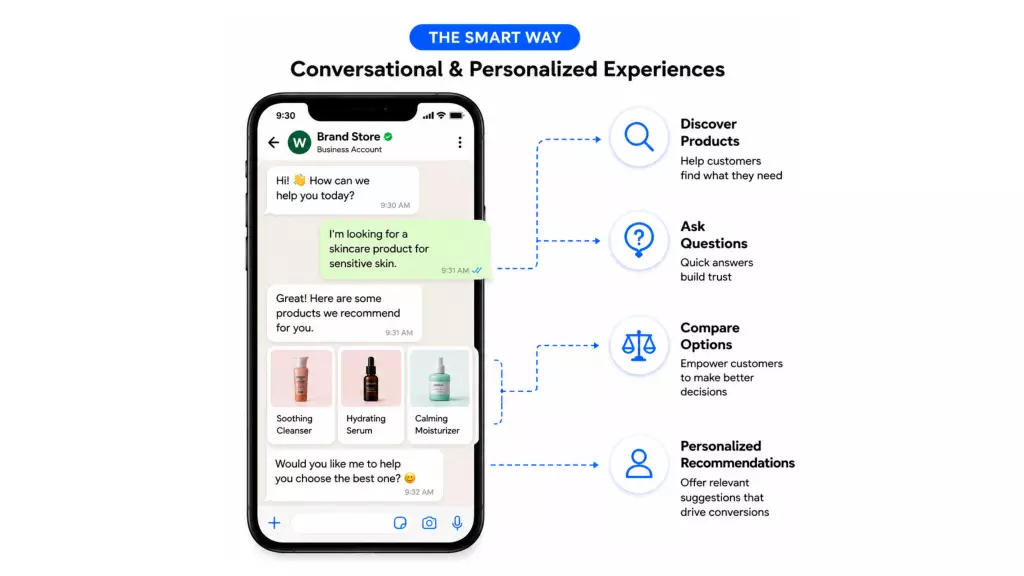
For example, rather than sending generic discount alerts, brands can use messaging flows that help customers:
- Discover products
- Ask questions
- Compare options
- Or receive personalised recommendations
The more interactive the experience becomes, the more effective the engagement usually is.
2. Use automation carefully
Automation remains one of the biggest advantages of WhatsApp marketing, especially for scaling customer communication. However, over-automation can quickly damage customer trust.
In 2026, successful businesses are using automation selectively. AI chat assistants are increasingly capable of handling FAQs, lead qualification, booking requests, order tracking, and routine support tasks. But customers still expect human intervention for complex or emotional interactions.
The most effective communication strategies combine:
- Intelligent automation
- Fast response times
- Seamless human handoffs
Businesses that rely too heavily on scripted interactions often create experiences that feel transactional and impersonal.
3. Prioritise consent and privacy
Privacy expectations are continuing to shape digital communication strategies globally. Customers are becoming far more conscious of how businesses collect, store, and use their information.
As a result, consent-based messaging has become essential.
Businesses should ensure customers clearly understand:
- What type of communication are they signing up for?
- How frequently will they receive messages?
- How can they opt out?
Overusing promotional broadcasts or messaging users without clear consent not only harms engagement but can also affect brand credibility and compliance.
Trust has become a major competitive differentiator in conversational marketing.
4. Build personalised customer journeys
Personalisation has moved beyond simply inserting customer names into messages.
Businesses are now expected to deliver contextual communication based on:
- Browsing behaviour
- Purchase history
- Customer preferences
- Support interactions
- Engagement patterns
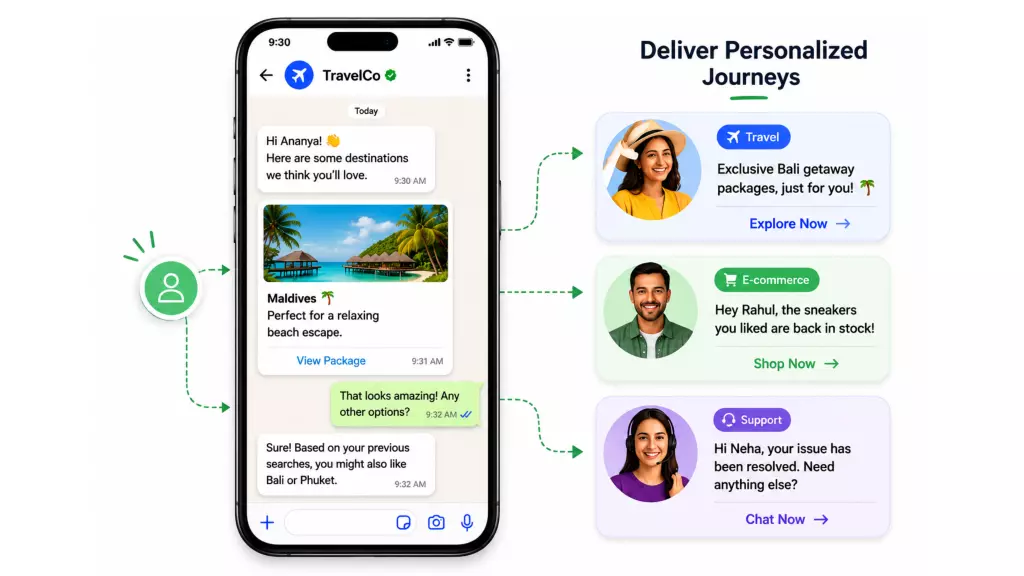
For example, a travel brand may send destination-specific recommendations based on previous searches, while an e-commerce business may provide personalised restock reminders or curated product suggestions.
The goal is to make interactions feel genuinely useful rather than algorithmically generated.
5. Integrate WhatsApp into broader customer experience systems
One of the biggest mistakes businesses make is treating WhatsApp as an isolated marketing tool.
In practice, messaging performs far better when connected with CRM platforms, support systems, analytics tools, payment infrastructure, and customer data platforms.
Integrated workflows allow businesses to:
- Maintain conversation history
- personalise communication more effectively
- automate follow-ups
- and create smoother customer journeys across channels
As omnichannel engagement becomes increasingly important, disconnected communication systems are becoming harder to manage efficiently.
6. Use Click-to-WhatsApp advertising strategically
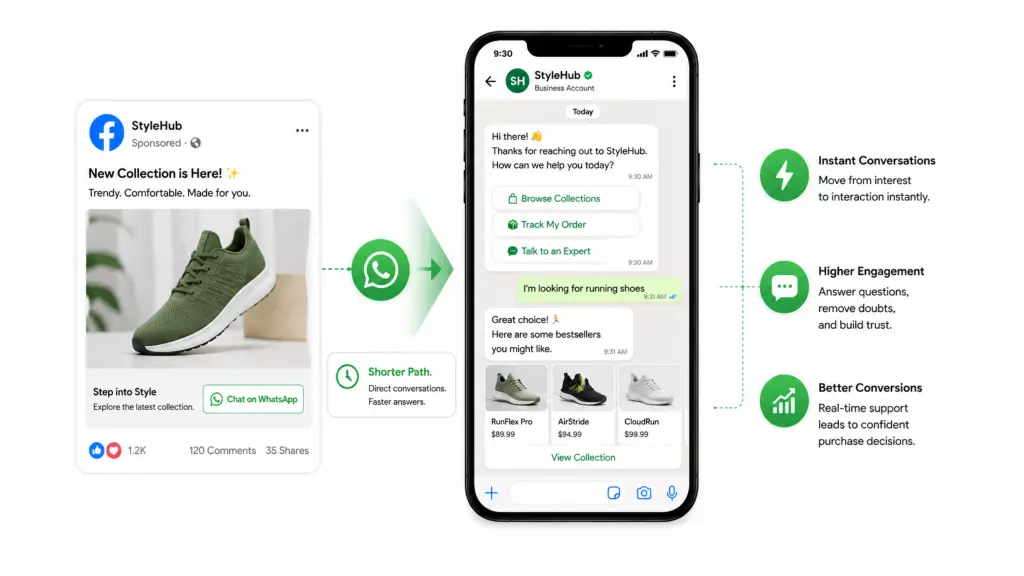
Click-to-WhatsApp ads continue gaining popularity because they shorten the path between discovery and conversation.
Instead of directing users toward lengthy forms or landing pages, businesses can move potential customers directly into messaging conversations where questions can be answered instantly.
However, the effectiveness of these campaigns depends heavily on response quality and speed. Driving traffic into poorly managed messaging experiences often creates friction rather than conversions.
Businesses should ensure they have:
- Structured conversation flows
- Trained support teams
- Clear escalation paths
before aggressively scaling messaging acquisition campaigns.
However, even well-planned WhatsApp marketing strategies can lose effectiveness when common execution mistakes are overlooked.
Common WhatsApp Marketing Mistakes Businesses Should Avoid
Several common mistakes continue to limit the effectiveness of WhatsApp marketing strategies.
- One of the most common mistakes is prioritising volume over relevance. Sending excessive promotional messages often leads to disengagement and opt-outs.
- Another issue is relying entirely on automation without considering customer experience. While AI tools have become far more advanced, customers can still recognise interactions that feel overly robotic or generic.
- Businesses often underestimate the importance of response timing. Messaging platforms create expectations of immediacy, and delayed replies can negatively affect engagement and trust.
- Poor segmentation is another recurring problem. Treating every customer the same typically reduces message relevance and weakens overall campaign performance.
- Finally, businesses that fail to measure customer satisfaction alongside conversion metrics often overlook long-term relationship quality
The Growing Role of AI in WhatsApp Marketing
Artificial intelligence is becoming increasingly central to business messaging strategies.
AI-powered systems can now:
- Summarise conversations
- Detect customer intent
- Recommend responses
- Automate workflows
- Personalise communication at scale
However, the future of conversational marketing is unlikely to be fully automated. Instead, businesses are moving toward hybrid engagement models where AI improves operational efficiency while human teams manage higher-value customer interactions.
This balance between automation and authenticity will become increasingly important as messaging ecosystems continue evolving.
The Future of Conversational Commerce
WhatsApp marketing is no longer simply a customer communication tactic. It is becoming part of a larger shift toward conversational commerce, where messaging platforms function as integrated environments for discovery, support, engagement, and transactions.
Consumers increasingly expect brands to meet them inside familiar digital spaces instead of forcing them through fragmented customer journeys. As a result, messaging is evolving from a support layer into a core business infrastructure component.
For businesses, the challenge is not whether to adopt WhatsApp marketing, but how to use it in ways that feel valuable, trustworthy, and genuinely customer-centric.
The brands that succeed will likely be those that treat messaging not as another advertising channel, but as an opportunity to build stronger long-term customer relationships through relevance, responsiveness, and meaningful conversation.