Mobile messaging has become the primary way people interact with brands daily. Consumers now spend more time in messaging apps than ever before, with WhatsApp alone serving more than 3.3 billion monthly active users globally as of January 2026 and projected to reach 3.5 billion by year-end. India remains the platform’s largest market, with 853.8 million users in 2024, while the average Indian user spends about 33.1 minutes on the app daily, totaling more than 6 hours per month. (Source: Resourcera)
Yet despite this massive engagement, most brands still send promotional messages using traditional SMS, a channel that confirms delivery but offers no visibility into whether the message was actually read, ignored, or deleted within seconds. This gap between “sent” and “seen” is costing brands engagement, trust, and revenue in an era where consumers expect instant, personalized, two-way conversations. You can dispatch thousands of texts, but without read receipts or click tracking, you’re operating blind.
The good news is that the infrastructure for better messaging now exists. The global RCS market is worth USD 3.59 billion in 2026 and is growing at a CAGR of 24.95%, projected to reach USD 10.93 billion by 2031. (Source: Mordor Intelligence) This rapid growth reflects a fundamental shift: enterprises are moving beyond SMS toward richer, measurable communication channels. In 2025, RCS entered a new phase of democratization as Google, telecom operators, and device makers accelerated adoption. With Apple’s iOS 18 now supporting RCS and Google Messages making it the default on Android, the pieces finally align for brands to move beyond plain-text SMS and into rich, interactive conversations. (Source: PR Newswire)
The Growing Gap Between Message Delivery and Customer Engagement
Mobile messaging remains one of the most effective ways for brands to reach customers, but success is no longer measured by whether a message is delivered. Today, the real challenge is capturing attention in an environment where consumers are constantly bombarded with notifications, promotions, and updates. Brands need to know not just that a message arrived, but whether it was opened, read, and acted upon.
While messaging channels continue to outperform email in terms of visibility and engagement, customer expectations have changed significantly. Consumers now interact daily with rich messaging experiences that include images, videos, quick-reply buttons, carousels, and real-time conversations. As a result, plain-text communication increasingly feels limited and disconnected from the way people naturally engage on their devices.
This shift is already influencing the telecom industry. Telecom operators report growing consumer preference for interactive messaging experiences over traditional SMS, reflecting a broader demand for more engaging, personalised, and action-oriented communication. Brands that continue to rely solely on basic text messaging risk falling behind as customer expectations continue to evolve.
The Visibility Economy: Why RCS Rewrites the Rules of Marketing Attribution
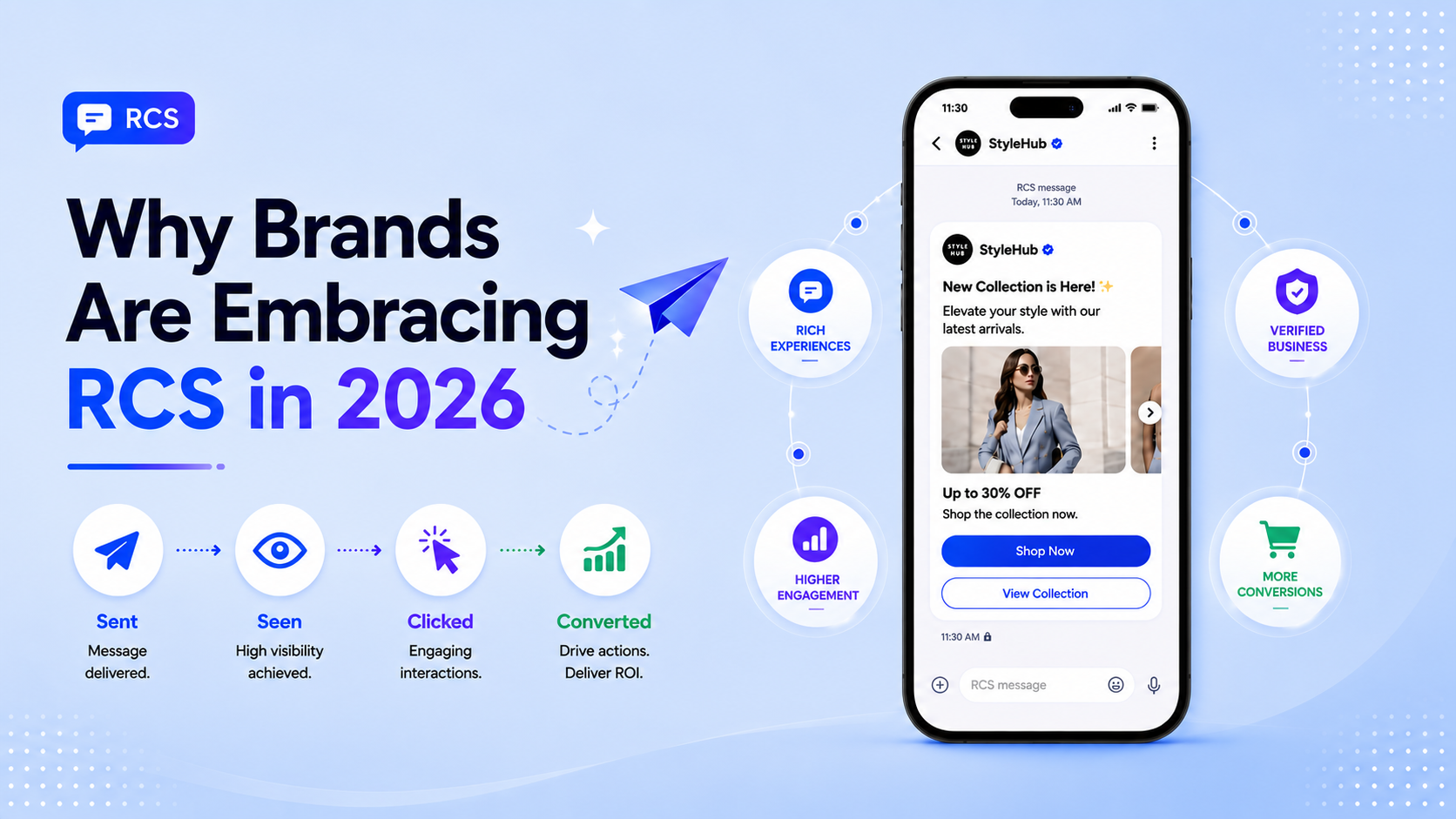
Today, marketing excellence isn’t about reach anymore; it’s about attribution. The brands winning in mobile messaging aren’t the ones sending the most messages; they’re the ones that can prove every message contributed to revenue. This is where the “sent → seen, clicked & converted” framework stops being a messaging upgrade and becomes a competitive moat.
Traditional SMS leaves brands flying blind. You send a promotional campaign to 100,000 customers, it delivers successfully, but you can’t tell which 10,000 actually opened it, which 5,000 clicked a link, or which 500 made a purchase. That blindness isn’t just frustrating, it’s financially devastating. In a data-driven marketing environment, you’re spending budget on campaigns you can’t optimize and can’t justify to stakeholders.
The shift toward measurable messaging is already happening across industries. R-Advertising’s analysis of RCS notes that organizations delaying adoption risk falling behind competitors who are already building sophisticated customer experiences. This isn’t about technology for technology’s sake; it’s about owning the data that proves your marketing works.
Think about the strategic implications: When you can track read receipts, you know your true open rates. When you can track button clicks, you know which products resonate. When you can track in-app purchases, you know your exact ROI per message. This isn’t incremental improvement; it’s the difference between marketing as a cost center and marketing as a revenue engine.
The competitive window is closing. By 2026, messaging will have become the decade’s biggest transformation in customer communication, yet brands that wait will lose ground to competitors using RCS to build richer, more transparent, and more profitable customer relationships. The question isn’t whether RCS will become standard; it’s whether your brand will lead the transition or chase it.
Seeing → Clicking → Converting: How RCS Transforms the Customer Journey
Stage 1: Seen-Visibility as Data Infrastructure
RCS provides real-time read receipts, so brands know precisely when messages are opened. This transforms messaging from a black box into measurable data. When you know what was read, you can optimize timing, personalize follow-ups, and prove true engagement rates to stakeholders. SMS already has exceptional open rates at 98%, but RCS adds the visibility layer that SMS lacks, confirming when messages are actually read. (Source: Shnoco)
Stage 2: Clicked-Interactivity That Removes Friction
RCS embeds clickable buttons, rich cards, and product carousels directly in the message. Instead of “click our link,” customers tap “Shop Now” on a product card without leaving the messaging app. SMS click-through rates average 19% and 36%, with anything over 20% considered excellent. RCS drives even higher engagement by reducing friction; interactive elements invite action rather than passive reading. (Source: Shnoco)
Stage 3: Converted-Closing the Loop Inside the Message
RCS eliminates multi-step funnels with in-app browsers and direct checkout. SMS conversion rates vary by industry: apparel (~1.0 to 2.0%), beauty (~1.5 to 2.0%), food & beverage (~2.0 to 3.0%). Early RCS adopters report 25% improvement in conversion rates for e-commerce compared to traditional SMS. The difference is accountability; you track which buttons convert which products, enabling true ROI attribution. (Source: Stimulate)
The transformation is complete: SMS sends into the void. RCS creates a measurable journey where every touchpoint drives revenue. This isn’t a feature enhancement; it’s turning messaging from a cost center into a revenue engine.
How Brands Can Achieve the Best with RCS
The brands getting the most out of RCS in 2026 aren’t the ones with the biggest budgets; they’re the ones treating it as a measurable revenue channel from day one. Here’s how they’re doing it:
- Start with high-intent use cases, not broadcast blasts: Focus on moments where customers already expect to take action, abandoned cart recovery, order confirmations with tracking, appointment reminders, and post-purchase follow-ups. These transactional and relationship-building use cases naturally outperform promotional broadcasts because customers are already engaged.
- Interaction design, not just display: Embed clickable buttons, product carousels, and quick-reply options directly in the message so customers can act without leaving the messaging app. Put the primary action above the fold, limit choices to avoid decision fatigue, and use rich media strategically. Images and videos increase engagement, but shouldn’t overload the message.
- Build measurement into every campaign from day one: RCS gives you data SMS never could, read receipts, click tracking, and conversion attribution. Track open rates, click-through rates, and conversion rates from your first send, then use this data to A/B test button copy, image usage, send times, and the number of action options.
- Scale what works, cut what doesn’t: Start with one high-intent flow and measure everything. Add a second use case once you’ve gathered baseline data. Scale to multiple flows and reallocate budget from underperforming SMS campaigns once you’ve proven ROI. Beyond the initial rollout, build advanced use cases like personalized product recommendations and in-app checkout. Treat RCS like a product that evolves based on data, not a campaign that launches and forgets.
- Choose infrastructure that removes friction, not adds it: The right platform should handle SMS fallback, provide verified sender IDs, offer analytics for read receipts and conversions, and maintain compliance with GDPR, TCPA, and India’s DLT registration. Services like TrustSignal’s RCS API offer enterprise-grade infrastructure with verified sender IDs, real-time analytics, and full DLT compliance out of the box, so brands can focus on messaging strategy rather than technical plumbing.
Conclusion
Mobile messaging is the primary way people interact with brands, yet most still send SMS without knowing if messages were read or acted upon. RCS closes this gap with 96% device coverage and real-time visibility into opens, clicks, and conversions, creating a measurable journey seen through read receipts, clicked through embedded buttons, and converted through in-app checkout.
The brands winning with RCS treat it as a measurable revenue channel, starting with high-intent use cases, designing for interaction, measuring everything, and choosing infrastructure that handles compliance and analytics out of the box.
The question isn’t whether RCS will become standard, it’s whether your brand will lead or chase. In 2026, marketing excellence isn’t about reach; it’s about attribution. SMS sends into the void. RCS creates a measurable journey where every touchpoint drives revenue.